
Web Scraping

Cursor AI and the other IDEs for smart coding

7 Pros of Cursor AI That Will Reshape The Future of Intelligent Coding

It will become a game-changer for web scraping and automation We have seen Visual Studio Code dominating the IDE market by providing minimal solutions to developers and enhancing the coding experience. As the AI-driven tools increasingly influence software development, now is the time to witness the arrival of a new integrated development environment, Cursor AI, that will enhance the future of intelligent coding. This IDE stands out as one of the most transformative tools for modern developers. Cursor AI, released in March 2023 by the startup Anysphere, has quickly grown into an enterprise-grade AI-powered code editor utilized by major tech firms and developer teams worldwide. Although developed as a fork of Visual Studio Code (VS Code), Cursor incorporates cutting-edge AI to augment all aspects of the coding process, including writing, refactoring, debugging, and maintaining giant codebases. How is Cursor AI different from others? Cursor is not a mere AI extension for your code editor. It is an AI-native IDE, where artificial intelligence is integrated into the very fabric of the product. Leaning on sophisticated language models such as OpenAI’s GPT-4, Anthropic’s Claude, and internal, in-house models, Cursor provides: Cursor AI Core Features 1. AI Code Autocomplete Low-latency, smart code suggestions appear while the developer types. Contextual snippets are encrypted, sent, processed by the AI, and delivered within less than a second. 2. AI Chat Assistant Integrates a chat agent that can refactor code, debug bugs, or insert features across many files with natural language commands. It can also browse the web with the @web command to augment answers. 3. Inline Edit Mode Developers can mark up code blocks and command changes to edit, rewrite, or optimize them on the fly. 4. Bugbot (AI Code Review) GitHub-integrated Bugbot reviews pull requests, marks issues, provides fixes, and even jumps directly to Cursor for instant application. 5. Background Agents AI processes long-running or computationally intensive tasks in separate VMs in the cloud, permitting developers to work without interruption. 6. Persistent Project Memory By storing “Rules” and “Memories,” project-specific logic and style preferences, Cursor ensures continuity from session to session. 7. Codebase Indexing & Semantic Search Utilizing encrypted vector embeddings and a bespoke vector database (Turbopuffer), Cursor allows developers to semantically search and navigate their entire codebase while upholding privacy at each step. Cursor AI’s Impact on Web Scraping & Data Extraction Companies Cursor is particularly strong for web scraping businesses, whose codebases tend to be big and repetitive and must evolve rapidly as websites change frequently. Benefits for Web Scraping Teams: For web scraping teams, Cursor AI provides revolutionary benefits that simplify operations and increase productivity. It enables scripts with natural language prompts, and developers can create web scrapers for new sites in seconds. Whenever websites update their HTML structure, Cursor automatically adjusts by refactoring all associated scraping logic, saving hours of manual work. It automatically combines proxy and CAPTCHA handling services such as ScraperAPI, Playwright, and 2Captcha with automated templates. Multiple files can undergo bulk changes, i.e., changing HTTP libraries or parsing frameworks made to them with a single command. Debugging is easier with Bugbot, which helps spot issues such as infinite retries, missing selectors, and faulty loops. With capabilities like parallel editing and smart automation, teams can deploy hundreds of scrapers efficiently without expanding their workforce. Infrastructure and Privacy Cursor employs a blend of AWS, Fireworks, OpenAI, Claude, Azure, and GCP for model hosting, with vector embeddings stored by Turbopuffer. All the code is Conclusion Cursor AI is not another code editor; it’s the future of software programming. For web scraping businesses and data teams, it provides the speed, intelligence, and flexibility required to thrive in an ever-changing digital environment. From smart code generation to AI-powered QA and debugging, Cursor has the potential to become a must-have in every technical stack. At Scraping Solution, a company known for delivering tailored scraping services to global industries, the adoption of Cursor AI has dramatically enhanced delivery speed, reduced error rates, and improved scalability. From lead generation to competitor analysis, Cursor AI empowers Scraping Solution to provide more robust, adaptable, and cost-effective data extraction tools to its clients.
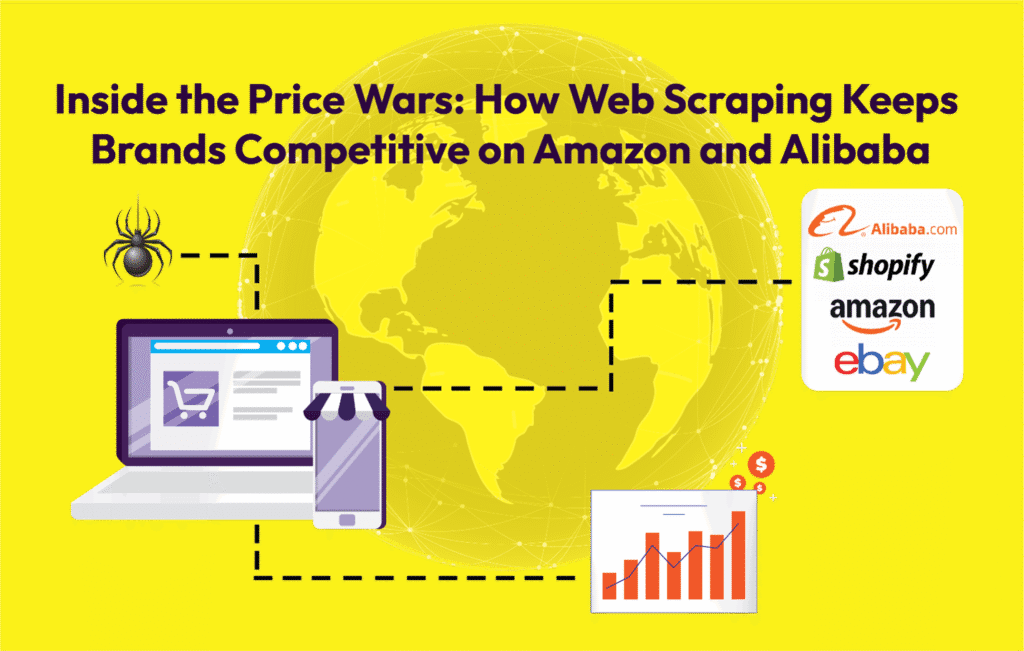
How Brands Use Web Scraping to Track Prices Across Global Marketplaces

In the borderless eCommerce economy of today, price is one of the most important elements that make or break a customer’s decision to buy your product or that of a competitor. With platforms such as Amazon, Alibaba, eBay, and Flipkart carrying millions of listings, brands often struggle to track how their products and those of their competitors are priced across different regions, making price monitoring a constant challenge. For global brands, manual tracking of these changes is not only inefficient but impossible. That is where web scraping has emerged as a go-to solution for international brands. In this article, we’ll explore the complete landscape of price tracking and its role in shaping eCommerce strategy. We’ll start by understanding why brands track prices across platforms and how it directly affects their revenue and competitiveness. Then, we’ll uncover how web scraping powers price tracking, exploring the tools, methods, and automation that enable it. We’ll also look at the complexity and data variety across global marketplaces, highlighting the technical challenges involved. From there, we’ll examine what types of data are collected and how this information fuels actionable business insights. Finally, we’ll discuss the real-world business impact and wrap up with the challenges and best practices that ensure accuracy, compliance, and scalability in price tracking systems.   Why Brands Track Prices Across Platforms Price tracking enables brands to stay competitive and profitable in an ever-changing digital market. Whether monitoring competitors’ discounts, understanding regional price differences, or adjusting in real-time to supply and demand, it’s the continuous and accurate tracking that makes sure businesses do not miss opportunities or erode margins. For instance: A brand on Amazon can track how rival sellers change prices during seasonal events. One can monitor the trend of international buyers on Alibaba and accordingly adjust their exports. Retailers can optimize pricing strategies across regions without losing visibility. In other words, tracking is no longer optional; it’s the backbone of eCommerce intelligence.   How Web Scraping Powers Price Tracking Web scraping can automate the process of gathering product prices, SKUs, availability, and promotions through hundreds or thousands of product listings on multiple websites. Scraping Solution utilizes tools like Python, Selenium, and APIs to create structured pipelines that fetch, clean, and deliver pricing data continuously in real time. The process looks like this: Identify Target URLs: Pages from marketplaces like Amazon, Alibaba, eBay, or Shopify-based stores. Extract Key Elements: Product title, price, discount, stock status, and seller name. Normalize Data: Standardize the currency, handle missing values, and remove duplicates. Deliver Insights: Export data in dashboards, APIs, or CSVs for analysis. This automated cycle lets brands monitor pricing shifts on an hourly basis, not monthly, and make agile responses. Platform Complexity and Data Variety Tracking across Amazon or Alibaba is not straightforward. Each of these platforms builds up its pages differently, using dynamic elements, while very often prices are hidden behind filters or JavaScript-loaded components. This means that generic scrapers fail fast, whereas custom scraping systems adapt to platform architecture for accuracy and reliability. Our systems handle: Multilingual listings Dynamic prices rendered by JavaScript Currency conversions Variations at the seller level: FBA vs third-party Product bundles and promotional pricing This adaptability ensures that no crucial pricing detail falls through the cracks.   What Data Is Collected Full price tracking scraper captures: Product titles and URLs Current and historical prices Discount percentages Stock status and availability Seller IDs and regions Date/time of last update Visualized, this information uncovers pricing trends, competitor moves, and market health in a go-to view that enables decision-makers to move with speed and accuracy. How It Translates into Business Impact Accurate price tracking fuels several key areas: Competitive Pricing: Dynamically adjust the prices to stay ahead of the competition. Revenue Optimization: Using real data so as not to under- or over-price. Product Strategy: Identify profitable regions or demand spikes. Brand Protection: Identify unauthorized sellers or inconsistent listings. Through visibility into the markets, the brands can make decisions based on facts, rather than estimates. Challenges and Best Practices Even with automation, price tracking faces some problems: Web structures tend to change often, so scrapers need maintenance. Some data is behind authentication or dynamic rendering. Scaling requires robust proxies and IP rotation systems. Scraping Solution, therefore, counts on best practices from ethical scraping protocols to strong data validation for clean, compliant, and real-time outputs. Scraping Solution: The Digital Bridge for Real-Time Market Insight  At Scraping Solution, we act as the digital bridge between marketplaces and decision-makers. Our scraping infrastructure turns chaotic, scattered pricing data into clean, connected insights. With our systems, brands don’t just monitor prices; they understand them. In eCommerce, each second counts, and with Scraping Solution, each second is tracked, analyzed, and optimized.

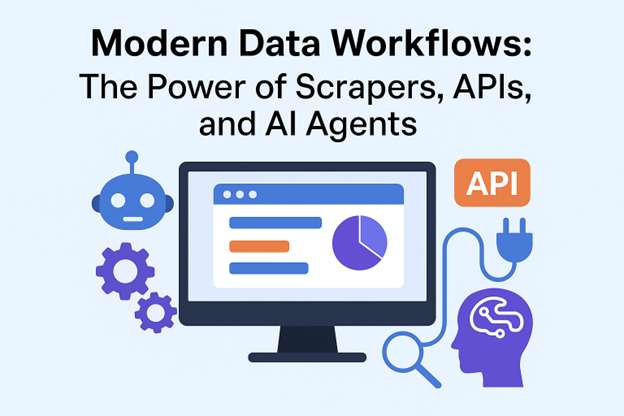
Modern Data Workflows: The Power of Scrapers, APIs, and AI Agents

In the digital world of today, smart data workflows are created by web scrapers, APIs, and AI agents. As data is a mechanism for decision-making, innovation, and business intelligence, its collection, processing, and delivering methodologies had a huge transformation over time. Gone are the old manual or semi-automated pipelines with connected ecosystems replacing them. To address these techniques, Scraping Solution is driving this change by creating a full-stack data automation platform meant to integrate every aspect of digital data collection, from extraction to insight. The Transformation of Data Workflows In the past, companies used disjointed tools: a web scraper for extraction, an API for integration, and a data analyst to interpret results. This siloed system caused inefficiencies, time lags, and data inconsistencies. Now, we’re entering the era of connected automation; where intelligent scrapers collect web data in real-time, APIs synchronize it across systems, and AI agents process it for insights instantly. The result? End-to-end automation with zero manual intervention. How It Works: Connecting the Dots The future data workflow combines three powerful technologies into one cohesive system: Web Scrapers: The Data Collectors At their core, web scrapers are electronic data gatherers who scan millions of websites to scrape structured data like product information, comments, prices, and market trends. They clean untidy online data into neat, usable formats like CSVs or APIs, ready to be analyzed or integrated. Today’s scrapers do more than static pages; they work on dynamic, JavaScript-powered sites, respond to layout alterations, and provide constant, real-time updates. Our scrapers at Scraping Solution are crafted to run smart and in scale, scraping data from thousands of sources, handling errors, and feeding business systems directly. From updating product catalogs to monitoring competitors and capturing leads, our automation pipelines provide accurate, ethical, and actionable data that enables eCommerce and retail brands to remain ahead of the game in an evolving digital landscape. APIs: The Data Bridges APIs are the digital bridges that tie various applications together, facilitating secure, real-time data transfer among platforms. They break down the limitations of manual transfers and siloed systems, making sure that information flows in an uninterrupted and efficient manner throughout business processes. In the current data-driven world, APIs are the pillars of automation that fuel everything from analytics dashboards to decision systems. At Scraping Solution, we natively integrate with in-house and external APIs to send structured, ready-to-action data directly into CRMs, analytics dashboards, and ERP systems. This process unifies dispersed workflows into a single data ecosystem where scraped insights are fed automatically into your business tools, keeping all departments aligned, in-sync, and able to move at a faster pace.   AI Agents: The Intelligent Decision-Makers The future of automation is in AI agents; smart systems with the power to reason, decide, and act on their own. AI agents don’t merely execute orders like standard scripts or bots do; they examine, learn, and act. They can in real-time process scraped data, identify emerging patterns, and react dynamically to new knowledge. This technology turns raw data into present insights, providing businesses with not just “what” but also the “what’s next.”   Why It Matters to Businesses Businesses no longer have an excuse for data lag. Real-time information directly converts into revenue chances, quicker choices, and a competitive edge. Whether it’s Monitoring market changes in eCommerce Identifying changes in consumer attitudes Creating B2B leads by means of smart filtering Automated data pipelines are changing the way businesses stay ahead. By bridging scrapers, APIs, and AI agents, Scraping Solution removes the friction between data harvesting and data action. Companies no longer simply collect data; they know it, act on it, and benefit from it in real time. The Scraping Solution Advantage Scraping Solution isn’t merely a scraping firm, it’s a full-stack data automation partner that enables digital-first businesses by: Custom automation pipelines designed around client workflows Scalable scrapers that dynamically adjust to website structures AI-driven insight engines for trend analysis and market forecasting API connections keeping systems in sync and current This intersection of scraping, automation, and AI enables us to provide groundbreaking data that operates in your favor, not against it. A Glimpse Into the Future The future belongs to organizations that can combine the speed of scrapers, the connectivity of APIs, and the intelligence of AI agents. As these technologies converge, they will redefine how data ecosystems operate, from static collection tools to dynamic, learning-driven systems. At Scraping Solution, we’re not just keeping pace with that future; we’re building it.

Navigating the Changes in Email Marketing: Google and Yahoo Introduce New Requirements for Bulk Email Sending

Navigating the Changes in Email Marketing Despite the significant reduction in spam compared to a decade ago or even the 2000s, it currently constitutes 48.6% of total global email traffic. To enhance safety and security, beginning February 1st, 2024, both Google and Yahoo will roll out new policies focused on enhancing email security and privacy. These policies will involve more stringent authentication requirements for senders, aiming to mitigate the risks of email spoofing and phishing attacks. Scraping Solution has written down some bullet points for its clients so they can easily understand the upcoming changes in email marketing and their implications. Here the new rules are: Implement SPF, DKIM, and DMARC email authentication protocols for their domains. Ensure that spam rates, as recorded in Google’s Postmaster Tools, remain below 0.1%, with the goal of never exceeding a spam rate of 0.3% or higher. Include a prominently displayed one-click unsubscribe link in the email body and promptly handle unsubscribe requests within a 2-day timeframe. Strictly send emails from their proprietary domains, avoiding the use of free email addresses such as Gmail or Yahoo. In the ever-evolving landscape of digital communication, email marketing remains a powerful tool for businesses to reach their audience. However, major players in the email service provider domain, such as Google and Yahoo, have recently introduced new requirements for bulk email sending. These changes are aimed at improving user experience, reducing spam, and enhancing overall email security. In this article, we’ll delve into the specifics of these new requirements and explore how marketers can adapt to ensure their email campaigns remain effective and compliant. 1. Google’s Requirements for Bulk Email Sending: Authentication Protocols:Google has implemented stricter authentication protocols to verify the legitimacy of email senders. Marketers are now required to adopt technologies like DKIM (DomainKeys Identified Mail) and SPF (Sender Policy Framework) to prove the authenticity of their emails. These protocols help in reducing the chances of phishing attacks and ensure that the emails reaching users’ inboxes are genuinely from trusted sources. DMARC Implementation:Domain-based Message Authentication, Reporting, and Conformance (DMARC) is another essential requirement introduced by Google. DMARC assists in preventing email spoofing and phishing by providing senders with detailed reports on email authentication failures. Marketers need to implement DMARC policies to enhance the security of their email communications. Dedicated IP Addresses:Google favors email senders with dedicated IP addresses over shared ones. A dedicated IP address ensures that the sender has more control over their email reputation, which plays a crucial role in email deliverability. Marketers should consider acquiring dedicated IP addresses to build and maintain a positive sender reputation. For more about how automation can streamline these processes, visit our Web Automation service page. 2. Yahoo’s Requirements for Bulk Email Sending: Sender Authentication:Similar to Google, Yahoo emphasizes sender authentication as a crucial aspect of email security. Marketers are required to implement DKIM and SPF authentication to validate the sender’s identity and reduce the likelihood of emails being marked as spam. Yahoo Mail Postmaster:Yahoo encourages marketers to register with the Yahoo Mail Postmaster service, a platform that provides valuable insights into email deliverability. By monitoring delivery metrics and feedback loops, marketers can identify and address issues promptly, ensuring their emails reach the intended recipients. Bulk Email Best Practices:Yahoo advises marketers to follow best practices for bulk email sending. This includes sending relevant and engaging content, maintaining a low complaint rate, and promptly handling unsubscribe requests. Adhering to these best practices helps build a positive sender reputation and enhances the overall effectiveness of email campaigns. Check out our Scraping Consultancy for expert guidance on maintaining data quality and compliance. 3. Adapting to the Changes: Regular Monitoring and Analysis:Marketers must adopt a proactive approach by regularly monitoring their email delivery metrics. Analyzing bounce rates, open rates, and spam complaints provides valuable insights into the performance of email campaigns and allows for timely adjustments to meet the new requirements. You can learn about our Data Mining services that help businesses make smarter marketing decisions. Collaboration with IT Teams:Close collaboration between marketing and IT teams is crucial in implementing the necessary authentication protocols and technical requirements. IT teams play a pivotal role in configuring DNS records, setting up DMARC policies, and ensuring the smooth transition to the new email sending requirements. Continuous Education and Compliance:Email marketers should stay informed about the latest developments in email authentication and deliverability standards. Continuous education ensures that marketing teams are aware of the evolving requirements and can adapt their strategies to maintain compliance. If you want assistance in automating and analyzing your email strategies, explore our Python Data Analysis service. Conclusion In conclusion, the recent introduction of new requirements by Google and Yahoo for bulk email sending marks a significant shift in the landscape of email marketing. These changes, centered around enhancing email security, privacy, and overall user experience, demand careful navigation from marketers. Authentication protocols like SPF, DKIM, and DMARC have become essential, emphasizing the need for businesses to establish and maintain a positive sender reputation. With Google and Yahoo setting stricter standards, the onus is on marketers to adapt swiftly. Dedicated IP addresses, registration with services like Yahoo Mail Postmaster, and adherence to best practices are crucial steps to ensure compliance. The aim is not only to combat spam but also to foster a trustworthy email environment that benefits both senders and recipients. As the digital realm continues to evolve, continuous monitoring of email metrics, collaboration between marketing and IT teams, and staying informed about industry updates will be key. The one-click unsubscribe link and prompt handling of unsubscribe requests reinforce the commitment to user privacy and regulatory compliance. Ultimately, the success of email marketing campaigns in this new era lies in the ability of businesses to embrace change, adhere to stringent requirements, and maintain a high level of transparency and trustworthiness. By doing so, marketers can not only navigate the evolving landscape effectively but also capitalize on the power of email as a strategic communication tool in the ever-competitive digital marketplace. Note:

Web Scraping Market Demand, Scope, Emerging Trends, Opportunities and Forecast 2032

Web Scraping Market Demand, Scope, Emerging Trends, Opportunities and Forecast 2032 The dynamic landscape of the digital age has ushered in an era where data is the lifeblood of informed decision-making for businesses across diverse sectors. In this data-driven paradigm, the significance of web scraper software has surged, becoming an indispensable tool for extracting, analyzing, and utilizing information sourced from the vast expanse of the internet. Scraping Solution delves into the intricate details of the Web Scraping Market (Both Product and Services), uncovering the current demand, expansive scope, emerging trends, enticing opportunities and forecasted trajectories up to the year 2032. This comprehensive analysis is a product of the meticulous research conducted by SPER Market Research, shedding light on the pivotal role web scraper software plays in navigating the intricacies of the digital landscape. The ever-expanding digital landscape has made data a valuable commodity for businesses and individuals alike. As a result, the demand for web scraper software has been steadily rising, driven by the need to extract, analyze and leverage data from the internet. This article explores the Web Scraper Software Market’s current demand, scope, emerging trends, opportunities, and forecasts for the year 2032, as researched and presented by SPER Market Research. Understanding the Web Scraper Software Market Web scraping is the automated process of extracting data from websites, enabling businesses to collect and analyze information for various purposes. This process has found applications across industries such as e-commerce, finance, market research and more. Web scraper software, a vital tool in this domain, is used to automate the extraction of data from websites at scale. Scope of the Web Scraper Software Market The web scraper software market has been witnessing significant growth due to several factors: Data-driven decision-making:In today’s data-centric world, organizations rely on data to make informed decisions. Web scraper software enables businesses to gather a vast amount of data from the web, helping them gain valuable insights into market trends, competitor activities, and consumer behavior. E-commerce Boom:The rapid expansion of e-commerce has created a massive demand for web scraper software. Businesses use these tools to monitor prices, track competitors, and optimize their own product listings. Financial Services:In the finance sector, web scraper software is used for real-time data collection, such as stock prices, news, and financial reports. This data is crucial for making investment decisions. Market Research:Market research companies use web scraper software to gather consumer sentiment, product reviews, and other data to assess market trends and customer preferences. AI and Machine Learning:The integration of web scraper software with AI and machine learning technologies has opened new avenues for data analysis, prediction, and automation. Emerging Trends in Web Scraper Software Several trends are shaping the web scraper software market: Cloud-Based Solutions:Cloud-based web scraper software offers scalability and accessibility, allowing users to extract data from any location with an internet connection. The global cloud computing market was estimated to be worth several hundred billion dollars, with forecasts of continued expansion at a rapid pace. Reports indicated that the market was growing at a significant annual rate, ranging from 17% to 20% or more. Factors driving this growth included the scalability, flexibility, and cost-efficiency of cloud solutions, enabling businesses to reduce infrastructure costs, access resources on demand, and support remote work initiatives. Adoption spanned various sectors, encompassing enterprise applications, healthcare, finance, education, e-commerce, and more. Additionally, emerging trends such as multi-cloud strategies, increased integration of AI and machine learning, emphasis on security, and hybrid cloud approaches were shaping the evolving landscape of cloud-based services. AI-Enhanced Scraping:Machine learning algorithms are being integrated into web scraper software to enhance data extraction accuracy and handle more complex websites. AI-enhanced scraping has been witnessing a growing trend within the web scraping landscape. AI-driven advancements were increasingly integrated into scraping technologies, improving their accuracy, efficiency, and ability to handle complex data. The incorporation of machine learning algorithms, natural language processing (NLP), computer vision, and other AI techniques allowed for more sophisticated and context-aware data extraction from websites. AI-enhanced scraping enabled systems to adapt to website changes dynamically, recognize patterns, and understand unstructured data, thus enhancing the quality and depth of information gathered. Web Scraping Regulations:With concerns about data privacy and ethical web scraping, there is a growing need for tools that adhere to legal and ethical guidelines. Regulations concerning web scraping were complex and varied across different jurisdictions and industries. There wasn’t a unified global framework specifically governing web scraping practices. Instead, legal boundaries were often defined by a combination of factors including copyright laws, terms of service of websites, data protection regulations (such as GDPR in the EU), and certain anti-competitive or computer misuse laws. For more details, see TechTarget on web scraping regulations. Mobile Web Scraping:As mobile usage continues to grow, web scraper software is adapting to collect data from mobile-optimized websites and apps. While traditional web scraping techniques primarily targeted desktop websites, mobile web scraping posed its own set of challenges and opportunities. With the growth of mobile traffic surpassing desktop usage in many regions, the need for extracting data from mobile interfaces has become crucial for various purposes including market research, competitive analysis, and mobile-specific data-driven strategies. Due to the rising significance of mobile data, the demand for effective mobile web scraping tools and methodologies is expected to increase. Real-Time Data:There is a growing demand for real-time data extraction to enable businesses to respond swiftly to changing market conditions. The overall web scraping market has been experiencing robust growth, with CAGR estimates ranging from 15% to 20% annually. Real-time data’s role in web scraping has been expanding due to its significance in acquiring up-to-the-minute information for immediate analysis and decision-making. Opportunities in the Web Scraper Software Market The web scraper software market is full of opportunities for both established companies and startups. Key areas of opportunity include: Niche Industries:Exploring niche industries and addressing their specific data extraction needs can be a lucrative opportunity for web scraper software providers. Customization:Offering highly customizable solutions to meet the unique requirements of clients can

11 Effective Way to handle Anti- Web Scraping Mechanisms

11 Effective Way to Handle Anti-Web Scraping Mechanisms With the rise in demand for web scraping and data mining across industries such as e-commerce, digital marketing, machine learning, and data analysis, anti-scraping techniques have also evolved, becoming smarter and harder to bypass. Anti-scraping mechanisms are implemented by websites to prevent automated scraping, often using tools like reCAPTCHA, Cloudflare, and DataDome. While it is crucial to respect a website’s terms of service, there are legitimate cases, such as research, market analysis, and business intelligence, where handling anti-scraping mechanisms properly is necessary. Scraping Solution has compiled expert-recommended strategies to help you manage these barriers effectively and maintain smooth, uninterrupted scraping and data collection processes. 1. Use an API Whenever possible, opt for an API (Application Programming Interface) rather than scraping HTML. Many websites provide APIs that give structured and authorized access to their data. APIs are built for this purpose and often include rate limits, authentication, and request control. Read the website’s API documentation carefully and use it to extract data efficiently. Since APIs are an authorized method, they are far less likely to block your requests. To learn more about working with APIs, check out Google Developers’ API Best Practices. If you need help integrating APIs into your scraping workflow, explore Scraping Solution’s web automation services. 2. Slow Down Requests Anti-scraping systems detect fast or repetitive requests from a single IP. To avoid this, introduce randomized delays between your requests and mimic human browsing patterns. For professional setups, Scraping Consultancy from Scraping Solution can help you build throttling and delay mechanisms without losing efficiency. 3. Rotate IP Addresses Rotating IPs helps prevent blocks caused by repeated requests from one address. Use proxies or VPNs to distribute traffic across multiple IPs. Some sites employ rate-limiting or IP blocking, so rotating IPs in combination with rotating user agents is highly effective. If you’re running large-scale scraping projects such as price comparison scraping or Google Maps data extraction, this technique is essential. 4. Use a Headless Browser Websites that load content dynamically via JavaScript won’t reveal complete data through standard HTTP requests. In such cases, use headless browsers like Puppeteer or Selenium. These tools render pages as real browsers would, allowing you to extract dynamically loaded elements. Scraping Solution’s web automation services also leverage these technologies for robust data collection. 5. Customize Headers Most anti-scraping systems analyze HTTP headers to detect bots. Customize your request headers to resemble legitimate browser traffic. Modify: User-Agent Accept-Language Referer Rotating or randomizing these headers across requests can make your bot activity appear more human-like. 6. Handle Cookies Websites use cookies to manage sessions and track users. Manage cookies properly — accept and send them with requests, and maintain them between page loads. Some sites require a valid session cookie to serve content. If you’re unsure how to automate cookie handling, Scraping Solution’s data automation experts can assist in building a stable session-based scraping system. 7. Handle CAPTCHAs CAPTCHAs are designed to block bots by verifying human behavior. Some CAPTCHAs can be bypassed through machine learning or third-party solving services, but note that this might violate website terms and could be illegal depending on jurisdiction. Always proceed ethically and with compliance. You can learn more about responsible scraping from Mozilla’s Web Scraping Ethics Guide. 8. Monitor and Adapt Websites continuously update their security systems. Regularly monitor your scraping results and adjust your methods when detection patterns change. Using automated error detection and adaptive algorithms can keep your scraping operation resilient. 9. Respect Robots.txt Always check the website’s robots.txt file before scraping. This file declares which parts of a site are disallowed for crawlers. If a site explicitly prohibits scraping certain pages, it’s best to honor those directives. You can automate this check within your scraper or consult Scraping Solution’s ethical scraping consultancy for compliance guidance. 10. Implement Polite Scraping Techniques If a website allows scraping, practice polite scraping to avoid overloading servers. This includes: Adding random delays between requests Respecting rate limits Avoiding simultaneous mass requests Polite scraping ensures stability, reduces detection risk, and builds credibility for long-term operations. Final Thoughts Web scraping and anti-scraping mechanisms are in a constant race of evolution. By combining ethical practices, technical expertise, and compliance, businesses can collect valuable data safely and responsibly. If you need expert support to design compliant and high-performing scraping systems, contact Scraping Solution or request a free consultation. Written By: Umar Khalid follow us on Facebook Linkedin Instagram