Data Extraction

Cursor AI and the other IDEs for smart coding

7 Pros of Cursor AI That Will Reshape The Future of Intelligent Coding

It will become a game-changer for web scraping and automation We have seen Visual Studio Code dominating the IDE market by providing minimal solutions to developers and enhancing the coding experience. As the AI-driven tools increasingly influence software development, now is the time to witness the arrival of a new integrated development environment, Cursor AI, that will enhance the future of intelligent coding. This IDE stands out as one of the most transformative tools for modern developers. Cursor AI, released in March 2023 by the startup Anysphere, has quickly grown into an enterprise-grade AI-powered code editor utilized by major tech firms and developer teams worldwide. Although developed as a fork of Visual Studio Code (VS Code), Cursor incorporates cutting-edge AI to augment all aspects of the coding process, including writing, refactoring, debugging, and maintaining giant codebases. How is Cursor AI different from others? Cursor is not a mere AI extension for your code editor. It is an AI-native IDE, where artificial intelligence is integrated into the very fabric of the product. Leaning on sophisticated language models such as OpenAI’s GPT-4, Anthropic’s Claude, and internal, in-house models, Cursor provides: Cursor AI Core Features 1. AI Code Autocomplete Low-latency, smart code suggestions appear while the developer types. Contextual snippets are encrypted, sent, processed by the AI, and delivered within less than a second. 2. AI Chat Assistant Integrates a chat agent that can refactor code, debug bugs, or insert features across many files with natural language commands. It can also browse the web with the @web command to augment answers. 3. Inline Edit Mode Developers can mark up code blocks and command changes to edit, rewrite, or optimize them on the fly. 4. Bugbot (AI Code Review) GitHub-integrated Bugbot reviews pull requests, marks issues, provides fixes, and even jumps directly to Cursor for instant application. 5. Background Agents AI processes long-running or computationally intensive tasks in separate VMs in the cloud, permitting developers to work without interruption. 6. Persistent Project Memory By storing “Rules” and “Memories,” project-specific logic and style preferences, Cursor ensures continuity from session to session. 7. Codebase Indexing & Semantic Search Utilizing encrypted vector embeddings and a bespoke vector database (Turbopuffer), Cursor allows developers to semantically search and navigate their entire codebase while upholding privacy at each step. Cursor AI’s Impact on Web Scraping & Data Extraction Companies Cursor is particularly strong for web scraping businesses, whose codebases tend to be big and repetitive and must evolve rapidly as websites change frequently. Benefits for Web Scraping Teams: For web scraping teams, Cursor AI provides revolutionary benefits that simplify operations and increase productivity. It enables scripts with natural language prompts, and developers can create web scrapers for new sites in seconds. Whenever websites update their HTML structure, Cursor automatically adjusts by refactoring all associated scraping logic, saving hours of manual work. It automatically combines proxy and CAPTCHA handling services such as ScraperAPI, Playwright, and 2Captcha with automated templates. Multiple files can undergo bulk changes, i.e., changing HTTP libraries or parsing frameworks made to them with a single command. Debugging is easier with Bugbot, which helps spot issues such as infinite retries, missing selectors, and faulty loops. With capabilities like parallel editing and smart automation, teams can deploy hundreds of scrapers efficiently without expanding their workforce. Infrastructure and Privacy Cursor employs a blend of AWS, Fireworks, OpenAI, Claude, Azure, and GCP for model hosting, with vector embeddings stored by Turbopuffer. All the code is Conclusion Cursor AI is not another code editor; it’s the future of software programming. For web scraping businesses and data teams, it provides the speed, intelligence, and flexibility required to thrive in an ever-changing digital environment. From smart code generation to AI-powered QA and debugging, Cursor has the potential to become a must-have in every technical stack. At Scraping Solution, a company known for delivering tailored scraping services to global industries, the adoption of Cursor AI has dramatically enhanced delivery speed, reduced error rates, and improved scalability. From lead generation to competitor analysis, Cursor AI empowers Scraping Solution to provide more robust, adaptable, and cost-effective data extraction tools to its clients.

AI Agents and Web Scraping: The 3 Next Step in Intelligent Automation

Introduction: In the rapidly evolving digital landscape of today, AI Agents are among the most revolutionary technologies to emerge. These independent systems can perform tasks that previously needed human input. Empowering AI agents with reasoning and learning capabilities unlocks a future where intelligence is not just processed but truly understood and evolved. When blended with web scraping, AI agents are revolutionizing how data is collected, processed, and utilized, ushering in the next generation of smart and intelligent automation. What Are AI Agents, and Why Do They Matter? AI agents are computer programs created to sense their surroundings, decide, and act to accomplish certain objectives, all with little human intervention. Unlike conventional automation tools that execute predetermined scripts, AI agents evolve and learn from context and data; that’s why they’re the future of intelligent automation. In the technology and business world, such agents are currently applied to: Gartner Emerging Tech Report predicts that at least 15% of day-to-day work decisions will be made autonomously through agentic AI by 2028, up from 0% in 2024. Besides supporting the increase in automation due to AI agents, this report also shows the negative perspective. Gartner addresses a call for extreme caution and strategic discernment before investing heavily in agentic AI in its current nascent stage. The Intersection of AI Agents and Web Scraping Web Scraping is the process of retrieving useful information from the web, which has always been critical for companies looking for a competitive advantage. But with the introduction of AI agents into the mix, the possibilities grow exponentially. With scrapers powered by AI, data gathering turns from rule-based retrieval to informed comprehension. Rather than merely gathering facts, these agents can: This convergence enables companies to create self-upgrading data pipelines that are quicker, more precise, and more dynamic than any human-operated system. A Changing Market Landscape and Intelligent Automation World Across sectors, smart automation is turning into a major differentiator. Companies that previously invested hours upon hours in manual research are now looking to adaptive, AI-powered tools to remain competitive. E-commerce sellers employ AI scraping software to monitor price fluctuations and stock changes before they affect sales. They are used by digital marketers to grab live leads from various platforms and instantly segment audiences. And financial institutions depend on real-time data collected by intelligent agents to predict market patterns. The outcome is a marketplace that works with unprecedented accuracy, continuously learning and responding faster. Scraping Solution: Powering the Future of Automation At Scraping Solution, we’re not just building scrapers; we’re building intelligence. Our automation systems integrate AI agents into web scraping workflows, enabling businesses to collect, refine, and act on web data smarter than ever before. We help eCommerce, retail, and B2B companies transform raw information into insight through: The major goal of Scraping Solution is to make data simple, enabling businesses to lead the way, act more quickly, and concentrate on growth rather than labor. Looking Forward: The Emergence of Smarter Data Ecosystems The future of automation isn’t about replacing people; it’s about amplifying intelligence. As Artificial Intelligence Agents become more sophisticated, they will allow businesses to not only scrape up data but also comprehend its significance in real time. Decision-making won’t rely on reported data that lags; it will be real-time, based on smart, self-improving systems. Firms that accept this change early will establish the pace of speed, accuracy, and flexibility in the digital economy. Conclusion: The intersection of web scraping and AI agents is a milestone for business intelligence. It’s not about automation; it’s about building systems that think. At Scraping Solution, we’re helping companies step into that future, one intelligent data pipeline at a time. Read our previous blog, where we provided a comparative analysis of the performance, cost, features, and user-friendly options of DeepSeek and ChatGPT.  

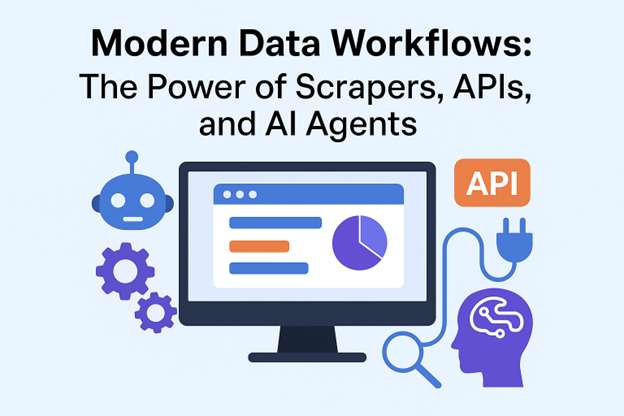
Modern Data Workflows: The Power of Scrapers, APIs, and AI Agents

In the digital world of today, smart data workflows are created by web scrapers, APIs, and AI agents. As data is a mechanism for decision-making, innovation, and business intelligence, its collection, processing, and delivering methodologies had a huge transformation over time. Gone are the old manual or semi-automated pipelines with connected ecosystems replacing them. To address these techniques, Scraping Solution is driving this change by creating a full-stack data automation platform meant to integrate every aspect of digital data collection, from extraction to insight. The Transformation of Data Workflows In the past, companies used disjointed tools: a web scraper for extraction, an API for integration, and a data analyst to interpret results. This siloed system caused inefficiencies, time lags, and data inconsistencies. Now, we’re entering the era of connected automation; where intelligent scrapers collect web data in real-time, APIs synchronize it across systems, and AI agents process it for insights instantly. The result? End-to-end automation with zero manual intervention. How It Works: Connecting the Dots The future data workflow combines three powerful technologies into one cohesive system: Web Scrapers: The Data Collectors At their core, web scrapers are electronic data gatherers who scan millions of websites to scrape structured data like product information, comments, prices, and market trends. They clean untidy online data into neat, usable formats like CSVs or APIs, ready to be analyzed or integrated. Today’s scrapers do more than static pages; they work on dynamic, JavaScript-powered sites, respond to layout alterations, and provide constant, real-time updates. Our scrapers at Scraping Solution are crafted to run smart and in scale, scraping data from thousands of sources, handling errors, and feeding business systems directly. From updating product catalogs to monitoring competitors and capturing leads, our automation pipelines provide accurate, ethical, and actionable data that enables eCommerce and retail brands to remain ahead of the game in an evolving digital landscape. APIs: The Data Bridges APIs are the digital bridges that tie various applications together, facilitating secure, real-time data transfer among platforms. They break down the limitations of manual transfers and siloed systems, making sure that information flows in an uninterrupted and efficient manner throughout business processes. In the current data-driven world, APIs are the pillars of automation that fuel everything from analytics dashboards to decision systems. At Scraping Solution, we natively integrate with in-house and external APIs to send structured, ready-to-action data directly into CRMs, analytics dashboards, and ERP systems. This process unifies dispersed workflows into a single data ecosystem where scraped insights are fed automatically into your business tools, keeping all departments aligned, in-sync, and able to move at a faster pace.   AI Agents: The Intelligent Decision-Makers The future of automation is in AI agents; smart systems with the power to reason, decide, and act on their own. AI agents don’t merely execute orders like standard scripts or bots do; they examine, learn, and act. They can in real-time process scraped data, identify emerging patterns, and react dynamically to new knowledge. This technology turns raw data into present insights, providing businesses with not just “what” but also the “what’s next.”   Why It Matters to Businesses Businesses no longer have an excuse for data lag. Real-time information directly converts into revenue chances, quicker choices, and a competitive edge. Whether it’s Monitoring market changes in eCommerce Identifying changes in consumer attitudes Creating B2B leads by means of smart filtering Automated data pipelines are changing the way businesses stay ahead. By bridging scrapers, APIs, and AI agents, Scraping Solution removes the friction between data harvesting and data action. Companies no longer simply collect data; they know it, act on it, and benefit from it in real time. The Scraping Solution Advantage Scraping Solution isn’t merely a scraping firm, it’s a full-stack data automation partner that enables digital-first businesses by: Custom automation pipelines designed around client workflows Scalable scrapers that dynamically adjust to website structures AI-driven insight engines for trend analysis and market forecasting API connections keeping systems in sync and current This intersection of scraping, automation, and AI enables us to provide groundbreaking data that operates in your favor, not against it. A Glimpse Into the Future The future belongs to organizations that can combine the speed of scrapers, the connectivity of APIs, and the intelligence of AI agents. As these technologies converge, they will redefine how data ecosystems operate, from static collection tools to dynamic, learning-driven systems. At Scraping Solution, we’re not just keeping pace with that future; we’re building it.

AI-powered web scraping

The Future of AI-Powered Web Scraping | Scraping Solution

How AI-Powered Web Scraping Is Transforming Data Collection and Automation Data was once a resource, but not the driver. Companies gathered information by hand, in tiny fragments of datasets, trusting in human interpretation to drive decisions. Data was more a history than a blueprint for the future. The present, however, tells a slightly different story. In the new age of technology, data is no longer passive; it’s the fuel that drives AI, automation, and innovation. For companies everywhere in eCommerce, fintech, real estate, marketing, and beyond, the power to see, understand, and act on web data is their competitive advantage. Historically, web scraping services has been the driving force behind this data revolution, enabling businesses to monitor competitors, track prices, aggregate product information, and gather consumer opinions. With advancements in large language models (LLMs) such as GPT-4.0, Claude Sonnet, and DeepSeek, organizations are leaving static datasets behind to move towards dynamic, real-time insights. The worth of information today resides not only in what occurred, but in being able to anticipate what’s next. With the rise of Generative AI and Agentic AI systems, the future of web scraping is no longer just about extracting data; it’s about understanding, reasoning, and automating entire decision-making workflows. The Traditional Role of Web Scraping For a long time, Web scraping has been an important tool utilized for : Lead generation scraping & customer insights Competitor monitoring (pricing, inventory, product details) Market research & trend tracking Sentiment analysis from reviews & social platforms Lead generation & customer insights But conventional scraping faces several challenges, like website data scraping with Anti bot measures that include CAPTCHA, scraping Dynamic websites containing JavaScript-heavy data that cannot be easily scraped, as data is changing rapidly. A major problem occurs when websites constantly change their site structure, which stops the scrapers from scraping data on previously added codes. Besides these barriers, Scalability and maintenance costs play a major role. Generative AI and Scraping: A New Paradigm Companies can now leverage AI scraping solutions instead of building rigid scripts. Generative AI models such as OpenAI’s GPT-4.0, Anthropic’s Claude Sonnet, and DeepSeek are transforming how data collection happens. Instead of building rigid scraping scripts that often break with website changes, companies can now leverage AI agents. To stay ahead in today’s data-driven environment, businesses need to rethink how they approach web scraping. Here’s how adaptation looks in practice: Constructing scrapers that adjust automatically to updating site layouts, rather than having to mend or redesign them each time a site changes. Use of natural language processing to interpret unstructured information such as customer feedback, extended articles, or bulletin board posts, and convert dirty data into tangible results. Automating the whole pipeline from data scraping to cleaning, enrichment, and analysis, minimizing the requirement for tedious manual work. Getting beyond APIs, as many only offer partial access. The dataset left by APIs could be scraped by scraping. This change means scrapers are turning from basic tools into smart agents that can navigate, think, and perform multi-step operations in real time. Agentic AI: The Future of Automation According to custom data scraping services, it could be understood by Smart Scheduling that agentic AI takes a step further as compared to Generative AI. Different from traditional models, agentic AI systems act as Autonomous Agents that are capable of planning, making decisions, and interacting with digital environments. According to web scraping, it could be understood by; Smart scheduling: Agents that understand when and what to scrape, according to business requirements. Ethical compliance: Agents that can verify legal limits before data gathering. Multi-modal integration: Gathering not only text, but also processing images, PDFs, and videos from the web. Continuous learning: Systems that enhance scraping efficiency the more they run. The Role of Large Language Models in Scraping Test LLMs such as GPT-4.0, Claude Sonnet, and DeepSeek are opening new possibilities for what scrapers can accomplish: GPT-4.0: Delivers sophisticated reasoning and contextual sense, allowing scrapers to become more intelligent at processing subtle information such as customer feedback or financial reports. Claude Sonnet (Anthropic): Famous for its safety and compliance orientation, which makes it perfect for ethically focused scraping operations. DeepSeek: An affordable, performance-oriented option that supports large-scale scraping and processing of data without being prohibitively expensive. Collectively, these models are the integration of scraping and AI-facilitated cognition, in which extraction is merely the first step, and interpretation is the true value generator. The Future of Web Scrapers Considering the scenarios of LLMs, Agentic AI, and Generative AI, developers are concerned about the future of web scrapers. Without being insecure, scrapers should be confident enough to merge their skills with AI by becoming AI agents that combine data extraction, analysis, and action in real time. The future predicts some beneficial aspects, like hybrid models (APIs +Scraping +AI) that will be the norm, ensuring data coverage where APIs will fall short. Trends, sentiments, and anomalies will be interpreted using custom LLMs fine-tuned on web data for businesses. Real-time compliance monitoring will reduce legal risks, powered by AI governance frameworks. Scrapers will handle millions of requests without constant developer oversight by increasing scalability without complexity. Scraping Solution’s Perspective At Scraping Solution, we’ve witnessed how companies suffer when they only use traditional approaches. Manual data scraping is no longer an option, and static scrapers frequently need to be repaired. That’s why we’re investing in AI-powered scraping and automation: Agent-based automation platforms that monitor and respond in real-time Machine learning-powered data pipelines to provide clean, actionable insights quickly and efficiently. It is clear to us from our experience that the future belongs to those companies that integrate scraping with AI. Conclusion Web scraping is no longer merely a matter of gathering information; it’s a matter of interpreting it in the moment and responding to it wisely. During the Age of AI, businesses that leverage Generative AI + Agentic AI + Automation will be able to gain a competitive advantage by taking raw web data and turning it into real-time actionable intelligence. Scrapers of the future,

Top global web scraping companies for data extraction and automation

Top 5 Web Scraping Service Providers Globally

Leading Web Scraping Companies Transforming Data Extraction The New Oil in Today’s Digital Economy is Data Businesses in the urge of utilizing data driven decision making need to effectively extract, analyze and utilize vast amounts of data. Here, web scraping services emerge as a crucial tool, by extracting vast amounts of publicly available data from websites. From the scraped data companies can uncover insights, track competitors, monitor market trends, and optimize their strategies to gain a competitive edge. Several companies are leading the charge in web scraping technologies and services all around the globe. The UK is home to a thriving tech ecosystem, playing a front role in data revolution, with several companies leading the charge in web scraping technologies and services. This article delves into the importance of web scraping in this digital age, the leading web scraping companies, their services, and how they are driving innovation in the field of data intelligence and data extraction. Top Web Scraping Companies The world is becoming “a hub for the companies that generate valuable insights from raw data” and it’s hard to choose the right and reliable ones. Below mentioned companies are marked top web scraping companies across the globe for their innovation, market research, accuracy, and efficiency. 1. Scraping Solution – The Specialist in Tailored Web Scraping Scraping Solution is a global leader in custom web scraping services, data extraction, and automation services. With over a decade of experience and thousands of successful projects, Scraping Solution has mastered the art of bypassing anti-bot mechanisms, handling complex websites, and delivering scalable, high-quality data to businesses worldwide. Check out the full range of services Scraping Solution offers here. Why Scraping Solution? Expertise in extracting data from eCommerce, real estate, finance, and B2B directories. Advanced anti-detection techniques, handling CAPTCHAs, proxies, and dynamic content. API integration for real-time data updates. Scalable solutions tailored to individual business needs. Strict compliance with data privacy regulations. Industries Served:E-commerce, Marketplaces, Finance, Lead Generation, B2B, Small Businesses, Competitive Intelligence. 2. Import.io Founded by Andrew Fogg and David White in 2012, a California based company that extracts data from websites. The Import.io engagement process regarding data extraction works upon the following steps: Project Kickoff Solution Design Project Delivery Ongoing Support Import.io Working Methodology The company does not compromise on the quality of data; their main goal is to deliver accurate, complete, reliable, and high-quality data at scale for customers. Moving forward with the motive that, “Data quality assurance is a key component of the managed service offering.” To make web data extraction easy, accurate, and worry free, Import.io takes several measures such as: Training the Extractor on Multiple Pages for better accuracy. After saving the extractor, optimizing and running it in the shortest period. Using patterns such as page numbers and category names to automatically generate all the required URLs in seconds. Excels in automatically detecting Paginated Lists. Compliance and accuracy through Website Screenshots. Assists in extracting authenticated data available only after logging in. Extracts images and documents with the rest of the data. Provides interactive workflows like navigating between pages, entering a search term, or changing sort order. Leverages machine learning auto-suggest for point and click training. 3. Scrapy (Anaconda) – Open-Source Web Scraping Framework Scrapy is a widely used open-source web crawling framework for Python, managed under the Anaconda ecosystem. It is ideal for developers and businesses that prefer in-house data extraction solutions. Why Scrapy? Fully customizable for advanced web scraping projects. Fast and efficient scraping with built-in asynchronous processing. Strong community support with regular updates. Great for machine learning and data science applications. Industries Served:Tech Startups, Data Science, AI/ML Development, Research Institutions. 4. Apify – Automation-Driven Web Scraping Apify offers a powerful cloud-based platform for web scraping, automation, and data processing. Its marketplace provides pre-built automation bots for scraping websites without extensive coding. Why Apify? Cloud-based infrastructure for large-scale data collection. Pre-built actors for scraping popular websites. Headless browser scraping with Puppeteer and Playwright. API integrations for seamless workflow automation. Industries Served:Retail, E-commerce, Marketing Intelligence, Startups. 5. Web Scraper IO – No-Code Web Scraping Tool Web Scraper IO is a Chrome extension-based web scraping solution that allows users to extract data from websites without writing code. It’s an excellent option for beginners and businesses that need quick data collection. Why Web Scraper IO? User-friendly, no technical skills required. Works directly within the browser. Affordable and accessible for small businesses. Offers cloud scraping for scheduled data extraction. Industries Served:Small Businesses, Digital Marketing, Research & Analysis. Conclusion Choosing the right web scraping provider depends on your business needs. If you’re looking for a custom-tailored, scalable, and compliance-driven solution, Scraping Solution is a top choice. Companies needing automated and large-scale scraping can benefit from Apify, while Scrapy serves developers looking for flexibility. Web Scraper IO is best for non-technical users who need quick, easy solutions. No matter which route you choose, having a strong web scraping strategy will unlock data-driven success in today’s competitive digital landscape.

LLMs in data extraction analyzing and contextualizing web data in real-time

How LLMs Are Revolutionizing Data Extraction in 2025

LLMs in Data Extraction | Enhancing Scraping with Context and Intelligence The 21st century’s innovation and decision-making of the large corporate sectors entirely rely on the data. The value and worth of technologies and businesses are measured by the amount of data they have. Large bulks of data occupy this century as it is growing exponentially. This leads us to a pivotal question, “How efficiently and precisely information or data patterns are fetched from large volumes of raw data?” The specialized form of data extraction that completely focuses on gathering data from websites is web scraping. Extracting data from structured or predictable formats is often easy and effective, but the main issue arises while dealing with unstructured or context-dependent data. Here LLMs emerge as game-changers with significant worth across multiple domains ushering in a transformative era. Large Language Models, also known as LLMs, are a category of foundation models that are pre-trained on enormous amounts of data. LLMs are larger than our imagination and expectation. They have billions of parameters that make them capable of dealing with complex tasks. Being powered by advanced natural language processing (NLP) capabilities, and offering real-time analysis, enhanced contextualization, and adaptability to various data scenarios, LLMs are bridging the gap exposed by traditional data mining or extraction techniques. Large Language Models (LLMs) are redefining data extraction processes and reshaping industries reliant on big data. Their ability to understand and generate natural language, process unstructured data, and adapt to domain-specific requirements makes them indispensable in the modern data-driven economy. 1. Adaptive Selectors: How LLMs Handle Website Updates with Ease With auto updating intelligent systems there is no need to update selectors, and XPaths. LLMs are capable of auto-updating, and ensuring scraping pipelines stay intact after major website updates. The days have arrived where we experience reduced downtime, resource saving, and keeping our scraping services seamless and consistent. The future of web scraping is completely reshaped by LLMs, making it robust and resilient than ever before. It’s time to embrace the evolution and leave outdated methods. 2. LLMs in Data Extraction Unstructured sources like email, PDFs, and web pages have always been a trouble for traditional extraction techniques. As trained on diverse datasets, LLMs excel in extracting valuable insights from vast, diverse, and unstructured datasets and can process natural language, tables, and multimedia data seamlessly. Traditional scraping often lacks context, requiring separate post-processing. With LLMs scraped data can be contextualized by identifying its relevance, tone, and deeper implications. LLMs have surpassed the traditional scraping by simultaneously extracting and analyzing data in real time. Instead of separating data collection and analysis into different phases, LLMs can process data as it’s being retrieved. Understanding the context of information enables LLMs to extract text such as names, dates, and trends more accurately and also identify anomalies. Handling and dealing with terabytes of data daily allows LLMs to automate labor-intensive tasks. 3. LLMs: Bypassing CAPTCHA and Dynamic Content Challenges Solving CAPTCHAs and handling dynamic content while web scraping has always been a challenge for the scrapers. LLMs have resolved these issues as they are embedded with web automation tools. Utilizing vision-based models or API integrations assists LLMs in bypassing obstacles that traditional scrapers struggle with. LLMs can interact with JavaScript-driven content, ensuring seamless data extraction even on highly dynamic platforms. 4. Transforming Industries Dependent on Big Data Industries dependent on large amounts of data are leveraging LLMs to enhance efficiency, reduce costs, and unlock new opportunities. Moreover, they are incorporating LLMs to make informed decisions so that they can compete in the fast-paced market. Let’s explore what LLMs can assist in industries. 1) E-Commerce and Retail Industry LLMs can extract and analyze competitor pricing data and match similar products across different platforms to optimize catalog management. Customer feedback and reviews provide customer choices and preferences that could be used for informed decision-making. This directly supports price comparison and e-commerce management. 2) Finance and Banking LLMs play a vital role in the Banking and Finance sectors in extracting critical data from loan agreements, invoices, or financial statements in addition to summarizing market news to assist in decision-making. 3) Healthcare To improve patient care and accelerate medical research, LLMs extract medical histories, prescriptions, or test results from patient records. They are also utilized to analyze large datasets from research papers and identify trends in treatments or diseases. LLMs also assist in drug development by extracting and analyzing biochemical research regarding drug discoveries. 4) Real Estate LLMs are used to extract details like pricing, amenities, and locations from property listings focusing on the trends from historical data and market reports. Services and offerings are designed and created based on customer preferences to enhance property management and market analysis. This aligns with properties detail scraping for real estate businesses. Conclusion By bridging the gap between raw data and actionable insights, LLMs are not just tools for data extraction but are catalysts for innovation in big data-dependent industries. LLMs are empowering businesses by automating complex processes, enhancing decision-making, and enabling scalability. Adopting these technologies provides access to unlimited innovation and growth. LLMs revolutionized the concepts of data extraction but on the other side industries and individuals must be aware of their challenges and ethical concerns, including data privacy, bias in data, high costs, and domain-specific expertise. To learn more about tailored solutions, explore Scraping Solution or get a custom quote.

Leveraging Web Scraping to Automate Data Collection in Google Sheets

Leveraging Web Scraping to Automate Data Collection in Google Sheets In today’s data-driven world, gathering information from the web is an essential task for many businesses and individuals. Web scraping – the process of extracting data from websites – has become increasingly popular due to its efficiency and versatility. When combined with Google Sheets automation, a powerful cloud-based spreadsheet application, web scraping can streamline data collection processes and enable seamless analysis and visualization. This article by Scraping Solution explores the synergy between web scraping and Google Sheets, highlighting its benefits and providing practical tips for implementation. Understanding Web Scraping Web scraping involves extracting structured data from web pages using automated tools called web scrapers or crawlers. These tools navigate through websites, locate specific information, and extract it into a usable format, such as CSV or JSON. Web scraping can be employed for various purposes, including market research, competitor analysis, lead generation, and content aggregation. Benefits of Web Scraping with Google Sheets Integrating web scraping with Google Sheets offers several advantages: Automation: Web scraping eliminates the need for manual data entry by automating the data extraction process. Once set up, the scraper can fetch updated information regularly, ensuring that your Google Sheets remain up-to-date without manual intervention. Real-time Data: By scraping data directly from websites, you can access real-time or near-real-time information, providing valuable insights for decision-making and analysis. Centralized Data Storage: Google Sheets serves as a centralized repository for scraped data, making it easily accessible and shareable with collaborators. This centralization fosters collaboration and ensures consistency across teams. Integration with Google Services: Google Sheets seamlessly integrates with other Google services, such as Google Drive, Google Forms, and Google Apps Script. This integration enables advanced automation and customization options, enhancing the functionality of your data workflows. Implementing Web Scraping in Google Sheets Here’s a step-by-step guide to implementing web scraping in Google Sheets: Identify Data Sources: Determine the websites from which you want to scrape data. Ensure that the websites allow web scraping and comply with relevant terms of service and legal regulations. Choose a Web Scraping Tool: Select a web scraping tool compatible with Google Sheets. Popular options include ImportXML, ImportHTML, and Google Sheets Add-ons like Apify. Configure Data Extraction: Use the chosen tool to configure data extraction parameters, such as URL, XPath, CSS selectors, or regular expressions. Test the extraction process to ensure accuracy and reliability. Import Data into Google Sheets: Utilize Google Sheets functions or scripts to import scraped data into your spreadsheet. Depending on the tool used, you may need to write custom scripts using Google Apps Script for more complex scraping tasks. Schedule Updates (Optional): Set up automated triggers or scripts to schedule periodic updates of scraped data. This ensures that your Google Sheets are consistently refreshed with the latest information. Best Practices and Considerations When implementing web scraping in Google Sheets, consider the following best practices: Respect websites’ terms of service and robots.txt directives to avoid legal issues. For example, GOV.UK’s data policy outlines acceptable data handling standards. Handle errors gracefully and implement error-handling mechanisms to deal with potential issues during scraping. Regularly review and update scraping configurations to accommodate changes in website structures or data formats. Monitor data quality and integrity to ensure the accuracy and reliability of scraped information. Conclusion Web scraping combined with Google Sheets offers a powerful solution for automating data collection, analysis, and visualization tasks. By leveraging the capabilities of web scraping tools and the collaborative features of Google Sheets, individuals and businesses can streamline their workflows, gain valuable insights, and make data-driven decisions more effectively. However, it’s essential to approach web scraping responsibly, respecting ethical considerations and legal regulations to maintain integrity and trust in data practices. With proper planning and implementation, web scraping in Google Sheets can significantly enhance productivity and efficiency in various domains. If you’re looking to automate data collection for your business, explore our Google Sheets Integration Services or contact us today to get started. For additional industry standards, you can also check the UK Data Service for compliance and open data resources.

Revolutionalize_Scraping

Revolutionizing Data Extraction

The Intersection of Artificial Intelligence and Web Scraping In the digital age, data is the new gold. Every industry, from e-commerce to finance, relies on vast amounts of data to make informed decisions and gain competitive advantages. With the proliferation of online content, web scraping has emerged as a critical tool for extracting valuable data from the web. However, the sheer volume and complexity of online data present significant challenges for traditional scraping methods. This is where artificial intelligence (AI) steps in, revolutionizing web scraping by enabling automated, intelligent data extraction at scale. Understanding Web Scraping Web scraping, also known as web harvesting or web data extraction, is the process of automatically collecting information from websites. Traditionally, this involved writing custom scripts or using scraping tools to navigate web pages and extract desired data elements. However, manual coding is time-consuming, error-prone, and limited in scalability, especially when dealing with large or dynamic websites. The concept of artificial intelligence in web scraping entails employing advanced algorithms and techniques to automate and optimize the extraction of data from websites. AI-driven scraping tools leverage machine learning, natural language processing, and computer vision to intelligently navigate through web pages, identify relevant content, and extract structured data accurately and efficiently. By analyzing webpage structures, understanding textual and visual content, and adapting to changes in website layouts, AI-powered scrapers can overcome challenges such as anti-scraping measures and dynamic web environments. This enables businesses to gather valuable insights from vast amounts of online data, enhance decision-making processes, and stay competitive in today’s data-driven landscape. The Role of Artificial Intelligence Artificial intelligence, particularly machine learning (ML) and natural language processing (NLP), has transformed the landscape of web scraping automation. By leveraging AI techniques, scraping tools can mimic human browsing behavior, understand webpage structures, and extract relevant information intelligently. Here’s how AI is revolutionizing web scraping: Automated Data Extraction: AI-powered scraping tools can automatically identify and extract data from web pages without explicit programming. These tools use machine learning algorithms to recognize patterns in webpage layouts and content, enabling them to extract structured data accurately and efficiently. Adaptive Scraping: Traditional scraping methods often fail when websites undergo layout changes or introduce new elements. AI-based scraping tools, however, can adapt to these changes by learning from past scraping experiences. Through continuous training and feedback loops, these tools can adjust their scraping strategies to maintain high accuracy and reliability over time. Content Understanding: One of the key challenges in web scraping is understanding unstructured or semi-structured content, such as text within articles or product descriptions. AI techniques, particularly natural language processing (NLP), enable scraping tools to parse and extract meaningful information from textual data. This includes identifying entities, extracting sentiment, and categorizing content, enhancing the quality and depth of scraped data. Anti-Crawling Bypass: Many websites deploy anti-scraping measures to prevent automated data extraction, such as CAPTCHA challenges or IP blocking. AI-powered scraping tools can circumvent these obstacles by dynamically adapting their scraping behavior to mimic human interactions. By simulating mouse movements, keyboard inputs, and session management, these tools can evade detection and access target websites more effectively. Visual Data Extraction: In addition to text-based content, AI enables scraping tools to extract information from images, videos, and other multimedia elements. Computer vision algorithms can analyze visual data, recognize objects or text within images, and extract relevant information for further processing. This capability is particularly valuable for e-commerce platforms, where product information often includes images and videos. Benefits of AI-Enhanced Web Scraping Web scraping, when enhanced with artificial intelligence (AI), offers a multitude of benefits across various industries and applications. Efficiency: AI-powered web scraping services automate the data extraction process, eliminating the need for manual intervention and repetitive tasks. Accuracy: Traditional web scraping methods may struggle with inaccuracies and inconsistencies, particularly when dealing with complex or dynamic websites. AI algorithms enhance the accuracy of data extraction by learning from past scraping experiences and adapting to changes in webpage layouts or content structures. Scalability: AI-driven web scraping frameworks are highly scalable, capable of handling large volumes of data from diverse sources simultaneously. Adaptability: Websites frequently undergo updates, redesigns, or layout changes, which can disrupt traditional scraping workflows. AI-powered tools can adapt dynamically to maintain reliability even in evolving environments. Content Understanding: AI techniques such as NLP and computer vision enable tools to understand and extract meaningful information from unstructured or semi-structured content. Anti-Crawling Bypass: Many websites implement anti-scraping measures to prevent automated data extraction. AI-powered scraping tools can bypass these by simulating human-like behavior. Data Quality Assurance: AI algorithms can improve the quality and consistency of scraped data by performing validation checks, error correction, and data deduplication tasks. Competitive Advantage: By leveraging AI-powered web scraping for market intelligence, competitor analysis, and trend monitoring, businesses can gain valuable insights and stay ahead in competitive markets. Applications of AI in Web Scraping The combination of AI and web scraping has wide-ranging applications across various industries: Market Research: Companies can use AI-powered scraping tools to gather market intelligence, monitor competitor activities, and track pricing trends. Financial Analysis: In the finance industry, AI-driven scraping tools are used to collect and analyze financial data from diverse sources, including regulatory filings and market websites. Lead Generation: AI-powered scraping tools enable marketers to automate lead generation processes by extracting contact information from directories, social networks, and other online sources. Content Aggregation: Publishers leverage AI-based scraping tools to collect and curate relevant content from across the web. Challenges and Ethical Considerations Despite its transformative potential, the use of AI in web scraping raises various challenges and ethical considerations: Data Privacy: Scraping sensitive or personal data from websites without proper consent may violate privacy regulations such as GDPR or CCPA. Intellectual Property: Scraping copyrighted or proprietary content without authorization may infringe upon intellectual property rights. Bias and Fair Use: AI algorithms used in web scraping may inadvertently perpetuate biases present in the training data or amplify existing inequalities. For guidance on responsible AI practices, refer to GOV.UK’s official AI regulation framework. Conclusion