
How Brands Use Web Scraping to Track Prices Across Global Marketplaces
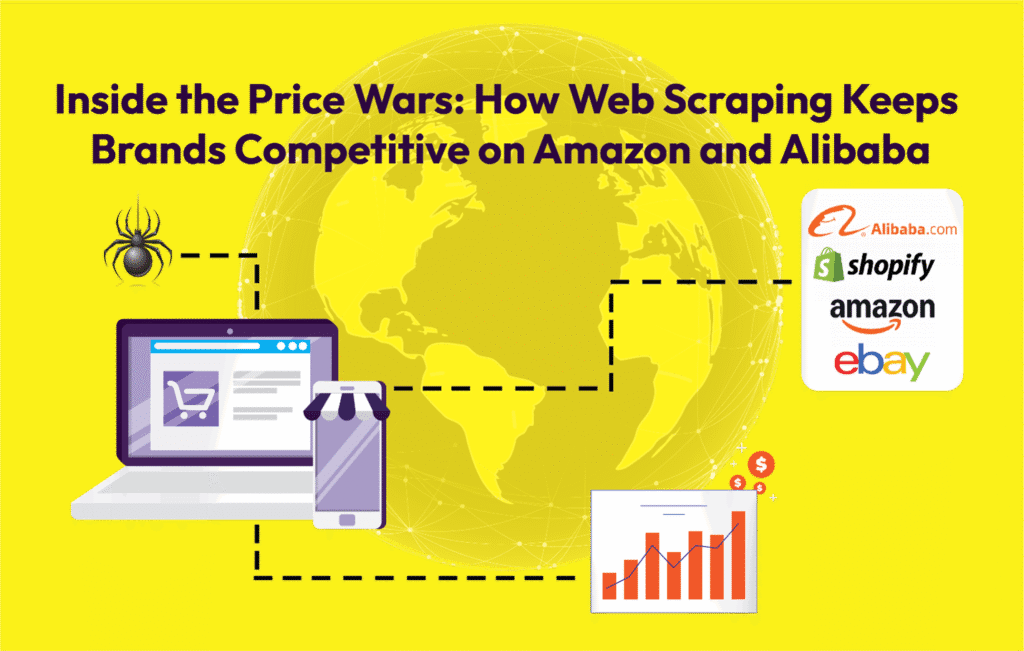
In the borderless eCommerce economy of today, price is one of the most important elements that make or break a customer’s decision to buy your product or that of a competitor. With platforms such as Amazon, Alibaba, eBay, and Flipkart carrying millions of listings, brands often struggle to track how their products and those of their competitors are priced across different regions, making price monitoring a constant challenge. For global brands, manual tracking of these changes is not only inefficient but impossible. That is where web scraping has emerged as a go-to solution for international brands. In this article, we’ll explore the complete landscape of price tracking and its role in shaping eCommerce strategy. We’ll start by understanding why brands track prices across platforms and how it directly affects their revenue and competitiveness. Then, we’ll uncover how web scraping powers price tracking, exploring the tools, methods, and automation that enable it. We’ll also look at the complexity and data variety across global marketplaces, highlighting the technical challenges involved. From there, we’ll examine what types of data are collected and how this information fuels actionable business insights. Finally, we’ll discuss the real-world business impact and wrap up with the challenges and best practices that ensure accuracy, compliance, and scalability in price tracking systems. Why Brands Track Prices Across Platforms Price tracking enables brands to stay competitive and profitable in an ever-changing digital market. Whether monitoring competitors’ discounts, understanding regional price differences, or adjusting in real-time to supply and demand, it’s the continuous and accurate tracking that makes sure businesses do not miss opportunities or erode margins. For instance: A brand on Amazon can track how rival sellers change prices during seasonal events. One can monitor the trend of international buyers on Alibaba and accordingly adjust their exports. Retailers can optimize pricing strategies across regions without losing visibility. In other words, tracking is no longer optional; it’s the backbone of eCommerce intelligence. How Web Scraping Powers Price Tracking Web scraping can automate the process of gathering product prices, SKUs, availability, and promotions through hundreds or thousands of product listings on multiple websites. Scraping Solution utilizes tools like Python, Selenium, and APIs to create structured pipelines that fetch, clean, and deliver pricing data continuously in real time. The process looks like this: Identify Target URLs: Pages from marketplaces like Amazon, Alibaba, eBay, or Shopify-based stores. Extract Key Elements: Product title, price, discount, stock status, and seller name. Normalize Data: Standardize the currency, handle missing values, and remove duplicates. Deliver Insights: Export data in dashboards, APIs, or CSVs for analysis. This automated cycle lets brands monitor pricing shifts on an hourly basis, not monthly, and make agile responses. Platform Complexity and Data Variety Tracking across Amazon or Alibaba is not straightforward. Each of these platforms builds up its pages differently, using dynamic elements, while very often prices are hidden behind filters or JavaScript-loaded components. This means that generic scrapers fail fast, whereas custom scraping systems adapt to platform architecture for accuracy and reliability. Our systems handle: Multilingual listings Dynamic prices rendered by JavaScript Currency conversions Variations at the seller level: FBA vs third-party Product bundles and promotional pricing This adaptability ensures that no crucial pricing detail falls through the cracks. What Data Is Collected Full price tracking scraper captures: Product titles and URLs Current and historical prices Discount percentages Stock status and availability Seller IDs and regions Date/time of last update Visualized, this information uncovers pricing trends, competitor moves, and market health in a go-to view that enables decision-makers to move with speed and accuracy. How It Translates into Business Impact Accurate price tracking fuels several key areas: Competitive Pricing: Dynamically adjust the prices to stay ahead of the competition. Revenue Optimization: Using real data so as not to under- or over-price. Product Strategy: Identify profitable regions or demand spikes. Brand Protection: Identify unauthorized sellers or inconsistent listings. Through visibility into the markets, the brands can make decisions based on facts, rather than estimates. Challenges and Best Practices Even with automation, price tracking faces some problems: Web structures tend to change often, so scrapers need maintenance. Some data is behind authentication or dynamic rendering. Scaling requires robust proxies and IP rotation systems. Scraping Solution, therefore, counts on best practices from ethical scraping protocols to strong data validation for clean, compliant, and real-time outputs. Scraping Solution: The Digital Bridge for Real-Time Market Insight At Scraping Solution, we act as the digital bridge between marketplaces and decision-makers. Our scraping infrastructure turns chaotic, scattered pricing data into clean, connected insights. With our systems, brands don’t just monitor prices; they understand them. In eCommerce, each second counts, and with Scraping Solution, each second is tracked, analyzed, and optimized.