How Brands Use Web Scraping to Track Prices Across Global Marketplaces

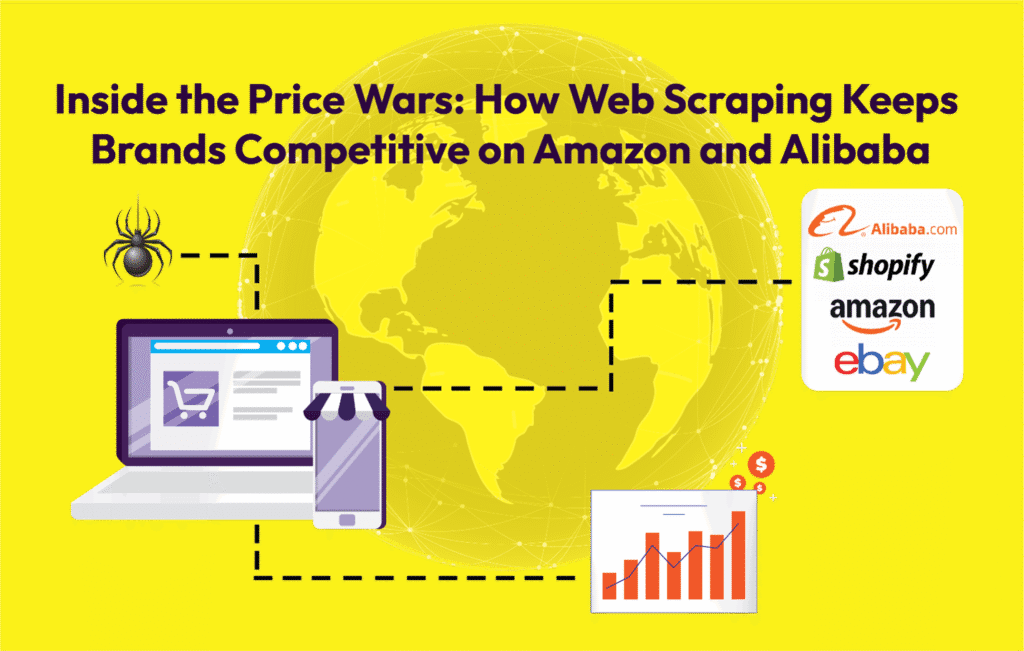
In the borderless eCommerce economy of today, price is one of the most important elements that make or break a customer’s decision to buy your product or that of a competitor. With platforms such as Amazon, Alibaba, eBay, and Flipkart carrying millions of listings, brands often struggle to track how their products and those of their competitors are priced across different regions, making price monitoring a constant challenge. For global brands, manual tracking of these changes is not only inefficient but impossible. That is where web scraping has emerged as a go-to solution for international brands. In this article, we’ll explore the complete landscape of price tracking and its role in shaping eCommerce strategy. We’ll start by understanding why brands track prices across platforms and how it directly affects their revenue and competitiveness. Then, we’ll uncover how web scraping powers price tracking, exploring the tools, methods, and automation that enable it. We’ll also look at the complexity and data variety across global marketplaces, highlighting the technical challenges involved. From there, we’ll examine what types of data are collected and how this information fuels actionable business insights. Finally, we’ll discuss the real-world business impact and wrap up with the challenges and best practices that ensure accuracy, compliance, and scalability in price tracking systems.   Why Brands Track Prices Across Platforms Price tracking enables brands to stay competitive and profitable in an ever-changing digital market. Whether monitoring competitors’ discounts, understanding regional price differences, or adjusting in real-time to supply and demand, it’s the continuous and accurate tracking that makes sure businesses do not miss opportunities or erode margins. For instance: A brand on Amazon can track how rival sellers change prices during seasonal events. One can monitor the trend of international buyers on Alibaba and accordingly adjust their exports. Retailers can optimize pricing strategies across regions without losing visibility. In other words, tracking is no longer optional; it’s the backbone of eCommerce intelligence.   How Web Scraping Powers Price Tracking Web scraping can automate the process of gathering product prices, SKUs, availability, and promotions through hundreds or thousands of product listings on multiple websites. Scraping Solution utilizes tools like Python, Selenium, and APIs to create structured pipelines that fetch, clean, and deliver pricing data continuously in real time. The process looks like this: Identify Target URLs: Pages from marketplaces like Amazon, Alibaba, eBay, or Shopify-based stores. Extract Key Elements: Product title, price, discount, stock status, and seller name. Normalize Data: Standardize the currency, handle missing values, and remove duplicates. Deliver Insights: Export data in dashboards, APIs, or CSVs for analysis. This automated cycle lets brands monitor pricing shifts on an hourly basis, not monthly, and make agile responses. Platform Complexity and Data Variety Tracking across Amazon or Alibaba is not straightforward. Each of these platforms builds up its pages differently, using dynamic elements, while very often prices are hidden behind filters or JavaScript-loaded components. This means that generic scrapers fail fast, whereas custom scraping systems adapt to platform architecture for accuracy and reliability. Our systems handle: Multilingual listings Dynamic prices rendered by JavaScript Currency conversions Variations at the seller level: FBA vs third-party Product bundles and promotional pricing This adaptability ensures that no crucial pricing detail falls through the cracks.   What Data Is Collected Full price tracking scraper captures: Product titles and URLs Current and historical prices Discount percentages Stock status and availability Seller IDs and regions Date/time of last update Visualized, this information uncovers pricing trends, competitor moves, and market health in a go-to view that enables decision-makers to move with speed and accuracy. How It Translates into Business Impact Accurate price tracking fuels several key areas: Competitive Pricing: Dynamically adjust the prices to stay ahead of the competition. Revenue Optimization: Using real data so as not to under- or over-price. Product Strategy: Identify profitable regions or demand spikes. Brand Protection: Identify unauthorized sellers or inconsistent listings. Through visibility into the markets, the brands can make decisions based on facts, rather than estimates. Challenges and Best Practices Even with automation, price tracking faces some problems: Web structures tend to change often, so scrapers need maintenance. Some data is behind authentication or dynamic rendering. Scaling requires robust proxies and IP rotation systems. Scraping Solution, therefore, counts on best practices from ethical scraping protocols to strong data validation for clean, compliant, and real-time outputs. Scraping Solution: The Digital Bridge for Real-Time Market Insight  At Scraping Solution, we act as the digital bridge between marketplaces and decision-makers. Our scraping infrastructure turns chaotic, scattered pricing data into clean, connected insights. With our systems, brands don’t just monitor prices; they understand them. In eCommerce, each second counts, and with Scraping Solution, each second is tracked, analyzed, and optimized.

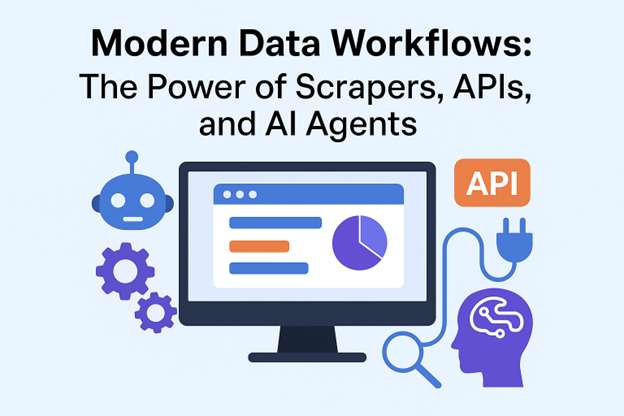
Modern Data Workflows: The Power of Scrapers, APIs, and AI Agents

In the digital world of today, smart data workflows are created by web scrapers, APIs, and AI agents. As data is a mechanism for decision-making, innovation, and business intelligence, its collection, processing, and delivering methodologies had a huge transformation over time. Gone are the old manual or semi-automated pipelines with connected ecosystems replacing them. To address these techniques, Scraping Solution is driving this change by creating a full-stack data automation platform meant to integrate every aspect of digital data collection, from extraction to insight. The Transformation of Data Workflows In the past, companies used disjointed tools: a web scraper for extraction, an API for integration, and a data analyst to interpret results. This siloed system caused inefficiencies, time lags, and data inconsistencies. Now, we’re entering the era of connected automation; where intelligent scrapers collect web data in real-time, APIs synchronize it across systems, and AI agents process it for insights instantly. The result? End-to-end automation with zero manual intervention. How It Works: Connecting the Dots The future data workflow combines three powerful technologies into one cohesive system: Web Scrapers: The Data Collectors At their core, web scrapers are electronic data gatherers who scan millions of websites to scrape structured data like product information, comments, prices, and market trends. They clean untidy online data into neat, usable formats like CSVs or APIs, ready to be analyzed or integrated. Today’s scrapers do more than static pages; they work on dynamic, JavaScript-powered sites, respond to layout alterations, and provide constant, real-time updates. Our scrapers at Scraping Solution are crafted to run smart and in scale, scraping data from thousands of sources, handling errors, and feeding business systems directly. From updating product catalogs to monitoring competitors and capturing leads, our automation pipelines provide accurate, ethical, and actionable data that enables eCommerce and retail brands to remain ahead of the game in an evolving digital landscape. APIs: The Data Bridges APIs are the digital bridges that tie various applications together, facilitating secure, real-time data transfer among platforms. They break down the limitations of manual transfers and siloed systems, making sure that information flows in an uninterrupted and efficient manner throughout business processes. In the current data-driven world, APIs are the pillars of automation that fuel everything from analytics dashboards to decision systems. At Scraping Solution, we natively integrate with in-house and external APIs to send structured, ready-to-action data directly into CRMs, analytics dashboards, and ERP systems. This process unifies dispersed workflows into a single data ecosystem where scraped insights are fed automatically into your business tools, keeping all departments aligned, in-sync, and able to move at a faster pace.   AI Agents: The Intelligent Decision-Makers The future of automation is in AI agents; smart systems with the power to reason, decide, and act on their own. AI agents don’t merely execute orders like standard scripts or bots do; they examine, learn, and act. They can in real-time process scraped data, identify emerging patterns, and react dynamically to new knowledge. This technology turns raw data into present insights, providing businesses with not just “what” but also the “what’s next.”   Why It Matters to Businesses Businesses no longer have an excuse for data lag. Real-time information directly converts into revenue chances, quicker choices, and a competitive edge. Whether it’s Monitoring market changes in eCommerce Identifying changes in consumer attitudes Creating B2B leads by means of smart filtering Automated data pipelines are changing the way businesses stay ahead. By bridging scrapers, APIs, and AI agents, Scraping Solution removes the friction between data harvesting and data action. Companies no longer simply collect data; they know it, act on it, and benefit from it in real time. The Scraping Solution Advantage Scraping Solution isn’t merely a scraping firm, it’s a full-stack data automation partner that enables digital-first businesses by: Custom automation pipelines designed around client workflows Scalable scrapers that dynamically adjust to website structures AI-driven insight engines for trend analysis and market forecasting API connections keeping systems in sync and current This intersection of scraping, automation, and AI enables us to provide groundbreaking data that operates in your favor, not against it. A Glimpse Into the Future The future belongs to organizations that can combine the speed of scrapers, the connectivity of APIs, and the intelligence of AI agents. As these technologies converge, they will redefine how data ecosystems operate, from static collection tools to dynamic, learning-driven systems. At Scraping Solution, we’re not just keeping pace with that future; we’re building it.

AI-powered web scraping

The Future of AI-Powered Web Scraping | Scraping Solution

How AI-Powered Web Scraping Is Transforming Data Collection and Automation Data was once a resource, but not the driver. Companies gathered information by hand, in tiny fragments of datasets, trusting in human interpretation to drive decisions. Data was more a history than a blueprint for the future. The present, however, tells a slightly different story. In the new age of technology, data is no longer passive; it’s the fuel that drives AI, automation, and innovation. For companies everywhere in eCommerce, fintech, real estate, marketing, and beyond, the power to see, understand, and act on web data is their competitive advantage. Historically, web scraping services has been the driving force behind this data revolution, enabling businesses to monitor competitors, track prices, aggregate product information, and gather consumer opinions. With advancements in large language models (LLMs) such as GPT-4.0, Claude Sonnet, and DeepSeek, organizations are leaving static datasets behind to move towards dynamic, real-time insights. The worth of information today resides not only in what occurred, but in being able to anticipate what’s next. With the rise of Generative AI and Agentic AI systems, the future of web scraping is no longer just about extracting data; it’s about understanding, reasoning, and automating entire decision-making workflows. The Traditional Role of Web Scraping For a long time, Web scraping has been an important tool utilized for : Lead generation scraping & customer insights Competitor monitoring (pricing, inventory, product details) Market research & trend tracking Sentiment analysis from reviews & social platforms Lead generation & customer insights But conventional scraping faces several challenges, like website data scraping with Anti bot measures that include CAPTCHA, scraping Dynamic websites containing JavaScript-heavy data that cannot be easily scraped, as data is changing rapidly. A major problem occurs when websites constantly change their site structure, which stops the scrapers from scraping data on previously added codes. Besides these barriers, Scalability and maintenance costs play a major role. Generative AI and Scraping: A New Paradigm Companies can now leverage AI scraping solutions instead of building rigid scripts. Generative AI models such as OpenAI’s GPT-4.0, Anthropic’s Claude Sonnet, and DeepSeek are transforming how data collection happens. Instead of building rigid scraping scripts that often break with website changes, companies can now leverage AI agents. To stay ahead in today’s data-driven environment, businesses need to rethink how they approach web scraping. Here’s how adaptation looks in practice: Constructing scrapers that adjust automatically to updating site layouts, rather than having to mend or redesign them each time a site changes. Use of natural language processing to interpret unstructured information such as customer feedback, extended articles, or bulletin board posts, and convert dirty data into tangible results. Automating the whole pipeline from data scraping to cleaning, enrichment, and analysis, minimizing the requirement for tedious manual work. Getting beyond APIs, as many only offer partial access. The dataset left by APIs could be scraped by scraping. This change means scrapers are turning from basic tools into smart agents that can navigate, think, and perform multi-step operations in real time. Agentic AI: The Future of Automation According to custom data scraping services, it could be understood by Smart Scheduling that agentic AI takes a step further as compared to Generative AI. Different from traditional models, agentic AI systems act as Autonomous Agents that are capable of planning, making decisions, and interacting with digital environments. According to web scraping, it could be understood by; Smart scheduling: Agents that understand when and what to scrape, according to business requirements. Ethical compliance: Agents that can verify legal limits before data gathering. Multi-modal integration: Gathering not only text, but also processing images, PDFs, and videos from the web. Continuous learning: Systems that enhance scraping efficiency the more they run. The Role of Large Language Models in Scraping Test LLMs such as GPT-4.0, Claude Sonnet, and DeepSeek are opening new possibilities for what scrapers can accomplish: GPT-4.0: Delivers sophisticated reasoning and contextual sense, allowing scrapers to become more intelligent at processing subtle information such as customer feedback or financial reports. Claude Sonnet (Anthropic): Famous for its safety and compliance orientation, which makes it perfect for ethically focused scraping operations. DeepSeek: An affordable, performance-oriented option that supports large-scale scraping and processing of data without being prohibitively expensive. Collectively, these models are the integration of scraping and AI-facilitated cognition, in which extraction is merely the first step, and interpretation is the true value generator. The Future of Web Scrapers Considering the scenarios of LLMs, Agentic AI, and Generative AI, developers are concerned about the future of web scrapers. Without being insecure, scrapers should be confident enough to merge their skills with AI by becoming AI agents that combine data extraction, analysis, and action in real time. The future predicts some beneficial aspects, like hybrid models (APIs +Scraping +AI) that will be the norm, ensuring data coverage where APIs will fall short. Trends, sentiments, and anomalies will be interpreted using custom LLMs fine-tuned on web data for businesses. Real-time compliance monitoring will reduce legal risks, powered by AI governance frameworks. Scrapers will handle millions of requests without constant developer oversight by increasing scalability without complexity. Scraping Solution’s Perspective At Scraping Solution, we’ve witnessed how companies suffer when they only use traditional approaches. Manual data scraping is no longer an option, and static scrapers frequently need to be repaired. That’s why we’re investing in AI-powered scraping and automation: Agent-based automation platforms that monitor and respond in real-time Machine learning-powered data pipelines to provide clean, actionable insights quickly and efficiently. It is clear to us from our experience that the future belongs to those companies that integrate scraping with AI. Conclusion Web scraping is no longer merely a matter of gathering information; it’s a matter of interpreting it in the moment and responding to it wisely. During the Age of AI, businesses that leverage Generative AI + Agentic AI + Automation will be able to gain a competitive advantage by taking raw web data and turning it into real-time actionable intelligence. Scrapers of the future,

How web scraping and automation transformed a clothing business

How Clients Transformed Their Clothing Business With The Help of Web Scraping and Automation

How AI-Powered Web Scraping Improved Efficiency and Customer Insights in the Apparel Industry The Challenge: One of our clients, Yunus Textile Mills from the clothing sector, before adopting web scraping, experienced a variety of operational inefficiencies that slowed growth and responsiveness. Trend research was done mostly manually. Instead of manual work, they could have leveraged web scraping services to automate this process. Quality Assurance teams spent time wading through fashion blogs, marketplaces, and social media, a tedious and error-prone task. Competitor tracking was imprecise, taking hours or days to compile pricing and design information, with no guarantee of accuracy. Customer mood was fragmented across platforms, needing to be manually compiled and slowing down actionable findings. Restocking was mostly a guess, resulting in overstock or lost sales. Brand was also hampered by slow product optimization from not having real-time feedback on reviews and returns. Pricing tactics were also impacted, with the lack of automated tracking leaving stale price points and lost market movements. Moreover, employees spent considerable time on manual data entry, which brought in human errors and further delayed decision-making. Consequently: Faulty or under quality product variations continued to be produced undetected. Their retail partners, from leading platforms such as Target.com, complained about quality variability and delayed updates. Strategic moments for real-time inventory optimization, trend-based design maneuvers, and competitive pricing were constantly missed. Internal teams became exhausted and demoralized, incapable of keeping up with the market pace despite efforts. The company wasn’t merely losing sales — it was jeopardizing huge contracts and its long-term reputation as a brand. Scraping Solution in Tech: Scraping Solution has been working in Web Scraping and Automation for the past 17 years. We have provided our services to different industry clients through our custom data scraping solutions, including a clothing brand team, a real estate property dealer, a travel agent, a tech enthusiast, and a practicing lawyer. Our expertise is rooted in delivering high quality, data driven insights tailored to empower our clients with clarity, precision, and actionable value. The Solution: Scraping Solution’s eCommerce Data Automation Suite The above-mentioned issues forced the client to reach Scraping Solution Ltd. for our eCommerce scraping services and automation expertise. Our development team first captured of all the data they were working with review data, SKU/DPCI data, target review sites for review scraping, their basic sentiment analysis code, and their BI dashboards. Their main goal was to automate the whole data pipeline, from ingestion and processing to end visualization. Utilizing our sophisticated scraping technology, we effectively scraped real-time data for each of their DPCIs. In addition, we scraped customer feedback over a period of 25 years and aggregated rich insights across their full product range. This large dataset was extremely valuable for further in-depth analysis during later stages of the project. Scraping Solution collaborated with the firm to implement a customized web scraping pipeline on all applicable platforms: Price Monitoring: Programmed competitor price monitoring scraping on major marketplaces and direct websites. Customer Sentiment Analysis: Gathered and processed customer reviews and ratings through Natural Language Processing (NLP). Inventory Optimization: Tracked real-time competitors’ stock levels to inform supply decisions. Lead Generation: Scraped qualified seller and buyer contact information from B2B platforms using our lead generation scraping solutions. Scraping completely automates the process by reducing errors and omissions, along with less consumption of resources, and providing highly effective results in the sheets.  With the help of web scraping, clients got clear and concise data, upon which the critical decisions could be made. End-to-End Data Pipeline for Sentiment Analysis for Apparel Industry We built a strong data pipeline with the use of AI powered scraping services, strong Python tools to scrape and analyze customer sentiment data for Yunus Textile Mills. The key technologies utilized were: 1. Data Extraction: Python libraries like `requests`, `Selenium`, and `json` were employed to scrape data in an efficient manner. Dynamic websites and JavaScript-rendered data were processed flawlessly with Selenium. 2. Data Parsing and Structuring: The scraped material was parsed with BeautifulSoup (bs4) for HTML parsing and structured with Pandas for processing and dumping into a database. 3. Text Analysis: We used the Natural Language Toolkit (nltk) for sentiment classification, keyword frequency analysis, and pattern identification in customer reviews. 4. Data Presentation: Visual analytics and dashboards were developed using Power BI to present insights clearly and actionably. 5. Real-Time Frequency: The system was set up for 24/7 real-time scraping to provide updated analysis and reporting. 6. Bypassing Protection Mechanisms: Sophisticated scraping obstacles like Cloudflare and ReCAPTCHA were addressed using proxy rotation, and, where feasible, we used direct API endpoints to guarantee stability and precision of data acquisition. Key Performance Indicators for Customer Sentiment Analysis in Apparel Retail The sentiment analysis project for Yunus Textile Mills demonstrated that the performance indicators were aimed at qualitative insight generation as well as quantitative measurement of customer sentiment. The KPIs were crafted to mirror real-time customer feedback and product performance indicators. Primary KPIs Derived from Customer Review Data These KPIs form the core of customer sentiment analysis, product performance, and brand perception. They were extracted using sophisticated natural language processing (NLP) and data analysis methodologies:  1. Sentiment Distribution Objective: Measure overall customer satisfaction levels. Approach: Sentiment classification (positive, neutral, negative) by using models like VADER, TextBlob, or BERT.  2. Key Negative Feedback Drivers Objective: Uncover repetitive product faults and pain areas. Examples: Color misrepresentation Misaligned variants Faulty stitching or inferior finishing Method: Keyword clustering and frequency analysis of negative feedback.  3. Highlighted Product Strengths Objective: Expose typically valued aspects of the products. Examples Excellent fabric quality Color matched expectations Excellent fit and texture Method: Phrase extraction from positive sentiment clusters.  4. Aspect-Based Sentiment Tracking Objective: Track sentiment trends on product features (e.g., fabric, color, size). Method: Aspect-based sentiment tracking using keyword-tagged polarity scoring.  5. Topic Modeling & Thematic Categorization Objective: Classify feedback into themes like product quality, packaging, delivery, and user experience. Tools: LDA (Latent Dirichlet Allocation), BERT.  6. Product Variant-Level Performance Objective: Contrast sentiment between variants (e.g., sizes, colors, designs). Method: Cross-referencing review sentiment with product metadata.7. Emotion & Intent Detection Objective: Determine underlying emotional tones like frustration, delight, disappointment, or

Comparison of multi-threading vs multi-processing vs multi-tasking in Python automation

Multi-Threading vs. Multi-Processing vs. Multi-Tasking

How Multi-Processing Powers True Parallel Execution In the world of automation and software development, performance optimization is of prime importance. Be it constructing a high-performance data scraper, executing a massive simulation, or designing a real-time application, knowing what’s going on behind the curtains in terms of how your program executes tasks can be the difference maker. That is where principles such as multi-threading, multi-processing, and multi-tasking come into action. In this article, our research team at Scraping Solution will demystify what each of these terms is, contrast their pros and cons, and identify the best tools and agents for dealing with concurrent or parallel execution in contemporary programming. 1.Multi-Threading A single process executes many threads in the same memory area, enabling simultaneous execution.  Types:Preemptive: The OS manages task switching (e.g., Windows, Linux).Cooperative: Voluntarily yielding control (older systems). Key Features Multiple threads occupy the same memory space. Lightweight and quicker to switch between threads. Ideal for I/O-bound operations such as network calls, file I/O, or scraping services. Pros and Cons of Multi-Threading: Multi-threading is more efficient in context switching. That enables effective use of memory. It is perfect for non-blocking, lightweight operations. While on the other hand, it is prone to race conditions and deadlocks. Also, it is not suitable for CPU-bound tasks as there is the Global Interpreter Lock (GIL) in Python. 2.Multi-Processing Multi-processing refers to multiple processes running simultaneously. Every process contains its own memory area, which prevents GIL constraints and enables true parallelism. Key Features: Every process is executed in its own memory space. Suited for CPU-intensive tasks such as intense computation or image processing. Supports real parallel execution on multi-core CPUs. Pros and Cons of Multi-Processing Multi-Processing has a plus point as it avoids Python’s GIL. It is more robust for long or intensive processes. The main advantage is that it crashes in a single process without impacting on the other processes. Drawbacks of Multi-Processing includes the higher use of memory. It takes a lot more time to begin and exchange information between processes (through pipes or queues). 3.Multi-Tasking Multi-tasking is the general idea of running several tasks simultaneously. It can be carried out through multi-threading, multi-processing, or asynchronous programming. Types: Preemptive Multi-tasking (OS-level): CPU time is allocated by the system to tasks. Cooperative Multi-tasking (App-level): Tasks give up control voluntarily. Pros and Cons of Multi-Tasking:Multi-tasking is ideal for OS-level task management, and basic background processes. It enhances system utilization along with enriching responsiveness for several users or tasks. The major disadvantage of multi-tasking is that it needs proper resource management to prevent performance problems. The best parallel processing libraries for Python Multi-Processing Libraries multiprocessing (Python Standard Library): The multiprocessing module enables you to execute independent processes rather than threads. A separate memory space is available for each process, and thus it does not suffer from Python’s Global Interpreter Lock (GIL) and delivers real parallelism. Key Features: Runs multiple tasks on several CPU cores. Ideal for CPU-intensive tasks (intensive calculations, image processing, etc.). Processes don’t share memory — communication through Queue, Pipe, or Manager. Ray: A basic distributed runtime and a set of AI libraries to help streamline machine learning computation workloads are provided by the Ray library, a homogenous foundation for scaling Python and AI applications. offloads and parallelizes workloads related to AI and machine learning onto CPUs, computers, and GPUs. Dask: Outside in, Dask looks a lot like Ray. With an integrated task scheduling system, support for Python data frameworks like NumPy, and the ability to expand from one machine to several, it is also a Python library for distributed parallel computing. One of the major differences between Dask and Ray is the scheduler. Dask has a centralized scheduler that processes all tasks for a cluster. Ray is decentralized, with each machine having its own scheduler, so any problems with a scheduled task are resolved at the level of the individual machine, not the entire cluster. Dispy: Dispy is a Python library for distributed and parallel computing that allows computations to be executed in parallel across several processors within one machine or across many machines in a cluster, grid, or cloud.It is especially appropriate for data-parallel (SIMD) paradigms in which a computation is called with various large sets of data separately. Pandaral·lel: The pandarallel library is a Python utility aimed at accelerating computation by parallelizing operations across several CPUs while using pandas. The library makes it possible for users to parallelize their pandas’ operations with just a one-line change in code, which can effectively cut computation time for large datasets. Ipyparallel: Based on the Jupyter protocol, the IPython Parallel (ipyparallel) library is a Python package and collection of CLI scripts for controlling groups of IPython processes. Ipyparallel supports many ways of doing parallel execution, such as the use of map to apply functions to sequences and dividing the workload evenly between accessible nodes. Also, it offers decorators to functions to run remotely or parallel always. Joblib: Joblib has two principal objectives: execute jobs in parallel, and don’t recalculate results if nothing has changed. These optimizations make Joblib a good fit for scientific computing, where reproducible results are holy. It is meant to support lightweight pipelining so that developers don’t have to parallelize operations and speed calculations, especially for computationally expensive tasks. Parsl: Python’s Parse library is meant to make text parsing simpler using the same syntax form as Python’s format() so that it becomes easier to learn and work with compared to the use of regular expressions. It is especially handy for extracting data from text, like parsing phone numbers, dealing with time text, and processing HTML tags Using instructions to the shell, Parsl enables you to run not just native Python programs but also any external software. Celery: Celery is an open-source library for Python asynchronous task queues that are centered on real-time processing and task scheduling. It is programmed to run tasks simultaneously on one or more worker nodes with multiprocessing, eventlet, or gevent. Multi-Threading Libraries Python’s Threading Library Python’s threading library is ideal for I/O-bound tasks, that are effective in processing multiple network requests. It does not use multiple CPU cores but assists in quicker execution. futures.ThreadPoolExecutor: It simplifies working with a pool of threads, async execution, and getting results cleanly. Its key features include Thread pooling built-in – no need to manually deal with threads. Provides clean, readable syntax with.submit() and.map(). Scrapy: Scrapy is a high-performance, open-source Python web crawling and scraping framework. For businesses needing professional web scraping services, this approach ensures scalability. Unlike threading or multiprocessing in traditional programming, Scrapy employs an asynchronous networking engine to manage multiple requests at once without creating multiple threads or processes. Key Concurrency Features: Executes non-blocking HTTP requests. Single-threaded, event-driven architecture. Use Twisted to deal with many requests at once. Optimized for I/O-bound operations (such as waiting on server responses). Multi-Tasking Libraries Asyncio: asyncio

MCP Servers for Web Scraping | Power, Pitfalls, and Practical Challenges

How MCP Servers for Web Scraping Improve Data Extraction Data is the push factor for today’s innovation, decision-making, and advancement. Every industry from healthcare to education, from business to governance, is influenced by data as it enables smarter insights, efficiency, and personalized experiences. It is proven that data empowers humanity to make informed decisions, foster economic growth, and improve quality of life on a global scale. Now the future belongs to those who can collect, analyze, and leverage data effectively transforming raw information into actionable knowledge that benefits society. Due to the immense need for data extraction, businesses and researchers are looking to gather substantial amounts of information by leveraging web scraping solutions to capture data from websites efficiently to capture data from websites efficiently without the need for manual extraction that requires intense labor work. With the passage of time web environments are growing more complex and traditional web scraping methods are failing to provide the required results. Significant issues that web scraping must face are the anti-scraping measures such as CAPTCHAs, IP bans, and rate limiting. At this point, Multi-Channel Processing (MCP) Servers become a vital component and demonstrate their value. These servers not only enhance web scraping by distributing requests across multiple channels but also reduce risk of detection and improving efficiency. At Scraping Solution, our team has extensively worked with Multi-Channel Processing (MCP) servers as part of our regular web scraping services. While we have been leveraging the power and flexibility of these servers in both static and dynamic channeling contexts, we felt it essential to go beyond mere usage and explore the underlying architecture and strategic value they bring to modern scraping workflows. This blog serves not just as an introduction but as a practical knowledge-sharing piece for those who are either new to web scraping or looking to enhance their current infrastructure. We will observe how they play such an enormous role in effective web scraping, also we will observe challenges and limitations of MCP servers and the difference between Manual Process Distribution vs. Dynamic Work Distribution. What Are MCP Servers? Multi-Channel Processing Servers as from the term ‘multi’ are high-performance computing environment systems that are designed to process and manage multiple streams of data simultaneously. These servers are efficient in distributing workloads across multiple cores or machines. They maximize request distribution through the utilization of various IP addresses, user agents, and session management strategies to simulate organic user behavior. How MCP Servers Improve Web Scraping As in the previous section we have explained that web scraping encounters problems such as: IP blocking, CAPTCHAs, and Rate Limiting. So, MCP servers address these challenges by providing minimal solutions such as: 1. Distributing Requests Across Multiple IPs Through IP rotation, MCP servers render it challenging for websites to identify and block scraping attempts. 2. Mimicking Human Behavior Employing randomized delays, mixed user agents, and natural click patterns to prevent triggering anti-bot systems. 3. Enhancing Speed and Reliability Parallel processing enables MCP servers to scrape data at a faster rate with high success rates. 4. Handling Failures Gracefully When a channel fails (e.g., because of an IP ban), the system will automatically be fallback to an alternative one without breaking the scraping process. In web scraping, MCP servers increase data extraction speed, avoid bottlenecks, and provide stable task execution using multi-threading and multi-processing methods. With advantages there are several challenges and drawbacks of MCP Servers. Challenges and Drawbacks 1. Complexity: Requires careful management of processes to avoid deadlocks and race conditions. 2. Higher Resource Consumption: More threads and processes demand increased CPU and RAM usage. 3. IP Rotation & Anti-Bot Challenges: High parallelization can trigger bot-detection mechanisms, requiring robust anti-blocking techniques. Although MCP servers have enormous influence on web scraping by overcoming  anti-bot measures, they still lack dealing with IP bans, CAPTCHAs, and  adaptive website defenses. This is where professional automation and scraping services can make a difference. To further enhance resilience and efficiency, scrapers need to consider how tasks are allocated whether through manual process allocation or dynamic work distribution. Manual Process Distribution vs. Dynamic Work Distribution While MCP servers assist in overcoming most web scraping hurdles, task distribution between servers and proxies is what matters in terms of efficiency and success rates. Two primary methods exist: Manual Process Distribution and Dynamic Work Distribution. Both have their own pros and cons based on scraping needs. Manual Process Distribution Manual Process Distribution refers to assigning scraping tasks to specific proxies or channels based on predefined rules. The distribution remains static unless manually reconfigured. This process is easy to set with minimal coding and rotation of proxy. Suits well for small-scale scraping with regular website structures.  Facilitates manual optimization per task or geolocations. With the benefits, also come the drawbacks. This approach’s efficiency varies upon workloads, it can’t dynamically adjust based on system resources. Also, resources are wasted if the process is completed before the expected time and remains idle. Manual Process Distribution is best for small scale projects having low frequency scraping and are good for highly predictable targets. Dynamic Work Distribution This method employs smart algorithms to dynamically distribute tasks according to real-time parameters such as proxy health, response rate, and success rate. This approach is adaptive and resilient as it automatically shifts tasks if a proxy fails or gets blocked. It manages resource utilization and loads balance across all available proxies for optimal throughput. It is ideal for large-scale scraping with constantly changing conditions. The drawbacks of Dynamic Work Distribution involve complex systems that require advanced logics. The need for robust infrastructure and monitoring systems led to higher initial cost. There could be slight latency due to real-time decision-making. Dynamic Work Distribution is appropriate for large-scale scraping projects with high-frequency data extraction processes and targeting with aggressive anti-bot measures. Infrastructure Overview of MCP Servers in Web Scraping Automation At Scraping Solution, we deploy a well-structured MCP (Multi-Channel Processing) infrastructure designed to handle high-volume data extraction with resilience, speed, and adaptability. These servers are built on a distributed architecture that supports both manual and dynamic channel allocation, ensuring efficient task distribution even under heavy load. Each MCP node operates as an isolated scraping agent, connected to a central task scheduler and database. This setup not only prevents bottlenecks but also allows seamless scaling based on workload. Channels can be dynamically assigned based on target website complexity, anti-bot measures, and expected latency. Redis is employed for in-memory task queues, while Docker containers isolate each scraper environment for consistency and

Pydoll – Is This the End of WebDrivers in Python Browser Automation?

How Pydoll Browser Automation is Transforming Web Scraping In the fast-paced realm of web scraping, efficiency is paramount. Traditional tools like Selenium and Playwright, while robust, often grapple with performance bottlenecks due to their synchronous operations. At Scraping Solution, our relentless pursuit of more agile and responsive alternatives led us to an emerging gem in the field: Pydoll. From relying on the synchronous functionality of web drivers that follow a strict sequential order where each task must be completed before the next one begins. We have seen selenium and playwright with driver-dependent architecture. Traditional web scraping libraries like requests or Selenium work synchronously. Synchronous functionality in web scraping refers to sending a request and waiting for a response before moving to the next request. This methodology results in delays, especially when dealing with hundreds or thousands of URLs. These libraries require plugins, offer limited callbacks, and support for basic evasion. Pydoll has been introduced that’s transforming the landscape of browser automation. It has taken the initiative of eliminating the need for traditional webdrivers by delivering native asynchronous performance. This feature includes handling thousands of concurrent connections, better utilization of system resources, having more responsive applications, and enabling cooperative multitasking. Unlike legacy or traditional tools like Selenium, that rely on browser-specific drivers such as ChromeDriver, GeckoDriver, and EdgeDriver, Pydoll innovates by leveraging direct browser communication protocols, by offering a more stable and efficient automation experience. In this article, we will explore how Pydoll stands apart in the crowded automation landscape by introducing its innovative features and will delve into its asynchronous architecture to human-like interaction patterns. Also, we will see how Scraping Solution empowers clients with Pydoll. Core Features of Pydoll: Below we will discuss Pydoll’s market leading innovations. WebDriver-less Architecture The disruptive innovation of Pydoll that the world had witnessed is the elimination of WebDriver intermediaries. Traditional tools like Selenium that created compatibility headaches and maintenance overhead and require matching driver versions to browser versions are now bypassed by Pydoll. It directly communicates with browsers via native protocols that reduces setup complexity and improves reliability. These features allow for simplified setup, enhanced stability, and cross-browser consistency. Native Asynchronous Design Pydoll’s async paradigm allows concurrent execution of multiple browser sessions by getting rid of Selenium’s synchronous blocking calls. This factor significantly boosts performance for scalable automation. Pydoll enables non-blocking operations for tasks like page navigation, element interaction, and network monitoring. This provides real-world scalability for web scraping, where parallel page processing is critical. Human-Like Interaction Patterns Created with the aim to mimic human browsing, developers have integrated behavioral algorithms with variable typing speed, mouse movement trajectories, and randomized delays that make Pydoll a human-like interaction library. This makes it hard for anti-bot systems like Cloudflare, and reCAPTCHA to detect automation. Also, Pydoll has built in CAPTCHA handling.   Comparative Analysis of Pydoll with Selenium, Scrapy, and Beautiful Soup   Features Pydoll Selenium Scrapy Requests Asynchronous Execution Yes No Yes No Speed & Performance High Slow High Slow Handling JavaScript Yes Yes No No Ease of Use Simple Complex Moderate Simple Resource Consumption Low High Low Low For businesses needing scalable and undetectable web scraping services, Pydoll offers a clear performance advantage. Real-World Applications of Pydoll As the traditional web scraping tools struggle with IP blocking from anti-bot systems, rate limiting, CAPTCHAs, resource-intensive concurrent operations, and maintaining session state across thousands of requests. Here, Pydoll’s native async architecture allows simultaneous processing of hundreds of pages within a single thread, a capability we integrate into our automation and scraping services for enterprise clients. As common CI/CD challenges are faced by traditional web drivers like, Browser tests as the slowest pipeline stage, resource contention in shared environments, artifacts lacking debugging context, and inconsistent environments causing false failure are now bypassed by Pydoll’s pipeline as it provides lightweight headless execution with minimal resource overhead. What are the best practices to adopt for maximizing Pydoll’s experience? The following are best practices for coders to implement and maximize the experience of coders. Adopting asynchronous execution throughout the code for best performance. Utilize precise selectors (IDs, unique attributes) for reliable element hunting. Carry out error handling with try/except blocks around high-priority procedures. Make use of the event system instead of polling for state changes. Appropriately terminate resources with async context managers. Hang on for elements instead of fixed sleep delays. Use practical interactions like type_keys() to avoid detection. Upcoming Features of Pydoll Auto-detection of Cloudflare Captcha  Fingerprint Generation & Rotation Proxy Rotation  Shadow DOM Access  As businesses rely on high-quality data. They are always seeking reliable, scalable, and undetectable web scraping, automation, and data mining services that can enhance their business growth. Scraping Solution is ready to provide its clients with Pydoll-powered solutions and deliver unmatched efficiency. Whether it’s competitive intelligence, real-time market data, or automated workflows, we are always ready to provide High-Speed Data Extraction, Anti-Detection Bypass, Structured Data Pipelines, and Custom Automation. Whether it’s competitive intelligence, real-time market data, or automated workflows, we are always ready to provide web scraping and automation services powered by Pydoll

Top global web scraping companies for data extraction and automation

Top 5 Web Scraping Service Providers Globally

Leading Web Scraping Companies Transforming Data Extraction The New Oil in Today’s Digital Economy is Data Businesses in the urge of utilizing data driven decision making need to effectively extract, analyze and utilize vast amounts of data. Here, web scraping services emerge as a crucial tool, by extracting vast amounts of publicly available data from websites. From the scraped data companies can uncover insights, track competitors, monitor market trends, and optimize their strategies to gain a competitive edge. Several companies are leading the charge in web scraping technologies and services all around the globe. The UK is home to a thriving tech ecosystem, playing a front role in data revolution, with several companies leading the charge in web scraping technologies and services. This article delves into the importance of web scraping in this digital age, the leading web scraping companies, their services, and how they are driving innovation in the field of data intelligence and data extraction. Top Web Scraping Companies The world is becoming “a hub for the companies that generate valuable insights from raw data” and it’s hard to choose the right and reliable ones. Below mentioned companies are marked top web scraping companies across the globe for their innovation, market research, accuracy, and efficiency. 1. Scraping Solution – The Specialist in Tailored Web Scraping Scraping Solution is a global leader in custom web scraping services, data extraction, and automation services. With over a decade of experience and thousands of successful projects, Scraping Solution has mastered the art of bypassing anti-bot mechanisms, handling complex websites, and delivering scalable, high-quality data to businesses worldwide. Check out the full range of services Scraping Solution offers here. Why Scraping Solution? Expertise in extracting data from eCommerce, real estate, finance, and B2B directories. Advanced anti-detection techniques, handling CAPTCHAs, proxies, and dynamic content. API integration for real-time data updates. Scalable solutions tailored to individual business needs. Strict compliance with data privacy regulations. Industries Served:E-commerce, Marketplaces, Finance, Lead Generation, B2B, Small Businesses, Competitive Intelligence. 2. Import.io Founded by Andrew Fogg and David White in 2012, a California based company that extracts data from websites. The Import.io engagement process regarding data extraction works upon the following steps: Project Kickoff Solution Design Project Delivery Ongoing Support Import.io Working Methodology The company does not compromise on the quality of data; their main goal is to deliver accurate, complete, reliable, and high-quality data at scale for customers. Moving forward with the motive that, “Data quality assurance is a key component of the managed service offering.” To make web data extraction easy, accurate, and worry free, Import.io takes several measures such as: Training the Extractor on Multiple Pages for better accuracy. After saving the extractor, optimizing and running it in the shortest period. Using patterns such as page numbers and category names to automatically generate all the required URLs in seconds. Excels in automatically detecting Paginated Lists. Compliance and accuracy through Website Screenshots. Assists in extracting authenticated data available only after logging in. Extracts images and documents with the rest of the data. Provides interactive workflows like navigating between pages, entering a search term, or changing sort order. Leverages machine learning auto-suggest for point and click training. 3. Scrapy (Anaconda) – Open-Source Web Scraping Framework Scrapy is a widely used open-source web crawling framework for Python, managed under the Anaconda ecosystem. It is ideal for developers and businesses that prefer in-house data extraction solutions. Why Scrapy? Fully customizable for advanced web scraping projects. Fast and efficient scraping with built-in asynchronous processing. Strong community support with regular updates. Great for machine learning and data science applications. Industries Served:Tech Startups, Data Science, AI/ML Development, Research Institutions. 4. Apify – Automation-Driven Web Scraping Apify offers a powerful cloud-based platform for web scraping, automation, and data processing. Its marketplace provides pre-built automation bots for scraping websites without extensive coding. Why Apify? Cloud-based infrastructure for large-scale data collection. Pre-built actors for scraping popular websites. Headless browser scraping with Puppeteer and Playwright. API integrations for seamless workflow automation. Industries Served:Retail, E-commerce, Marketing Intelligence, Startups. 5. Web Scraper IO – No-Code Web Scraping Tool Web Scraper IO is a Chrome extension-based web scraping solution that allows users to extract data from websites without writing code. It’s an excellent option for beginners and businesses that need quick data collection. Why Web Scraper IO? User-friendly, no technical skills required. Works directly within the browser. Affordable and accessible for small businesses. Offers cloud scraping for scheduled data extraction. Industries Served:Small Businesses, Digital Marketing, Research & Analysis. Conclusion Choosing the right web scraping provider depends on your business needs. If you’re looking for a custom-tailored, scalable, and compliance-driven solution, Scraping Solution is a top choice. Companies needing automated and large-scale scraping can benefit from Apify, while Scrapy serves developers looking for flexibility. Web Scraper IO is best for non-technical users who need quick, easy solutions. No matter which route you choose, having a strong web scraping strategy will unlock data-driven success in today’s competitive digital landscape.

Choosing between DeepSeek-R1 and ChatGPT for AI-powered automation and data projects

DeepSeek-R1 vs ChatGPT – Complete Guide to AI Performance

Comparing DeepSeek-R1 vs ChatGPT – Performance, Cost, and Accessibility Large Language Models (LLMs) have started a cyber war of achieving Artificial General Intelligence (AGI). ChatGPT and Deep Seek R1 are prominent large language models that have revolutionized the tech world by their potential, accuracy, achievements and efficiency. These models are reshaping the tech industry. In this article we’ll compare both the models at various proficiency levels. Developmental Origin: ChatGPT was launched in November 2022, by American research organization known for its advancements in artificial intelligence named OpenAI. OpenAI has several other models such as GPT-4, GPT-4o mini, o1 and o1 mini, GPT-4 turbo, GPT-3.5 Turbo, Whisper, Dall-e and much more. R1 was launched in January 2025, developed by Deep Seek a Chinese Company located in Hangzhou. Deep Seek is an AI company developing models to achieve Artificial General Intelligence (AGI). It has several other models like; DeepSeek-V3, DeepSeek-V2.5, DeepSeek-R1-lite, etc. Performance and Efficiency: The above image demonstrates the Accuracy/Percentile of models; DeepSeek-R1, OpenAI-o1, DeepSeek-R1-32B, OpenAI-o1-mini, and DeepSeek-V3. The first parameter taken in the above image AIME represents accuracy in solving advanced math problems. The analysis shows a 79.8 % score of DeepSeek-R1 while OpenAI-o1 model 79.2%.The Codeforces percentile represents programming and problem-solving capabilities. DeepSeek-R1 achieved an accuracy of 96.3% while OpenAI-o1 scored 96.6%.GPQA Diamond percentile demonstrating Question-Answer tasks. Here OpenAI-o1 achieved 75.7% surpassing DeepSeek-R1 which achieved 71.5%.The MATH-500 benchmarks math-solving capabilities. DeepSeek-R1 is ahead scoring a percentile of 97.3%, while OpenAI-o1 scored 96.4%.MMLU evaluates understanding across multiple knowledge domains. OpenAI-o1 outperforms by achieving 91.8% while DeepSeek-R1 scored 90.8%.SWE-bench Verified tests software engineering-related challenges. 49.2% scored by DeepSeek-R1 while 48.9% scored by OpenAI-o1. DeepSeek-R1 consistently outperforms major benchmarks as compared to other models. OpenAI models; o1 and o1-mini also performed well but lag slightly as compared to DeepSeek-R1. For businesses leveraging web automation and scraping services, performance and efficiency benchmarks are critical when selecting the right AI model. Cost Efficiency: DeepSeek-R1 excelled in cost efficiency as being approximately 27 times cheaper per token compared to OpenAI’s models. Deep Seek price for one million tokens starts at $0.14, which is much lower than OpenAI’s model, which costs $7.50 for the same token volume. DeepSeek-R1 model was trained at 6 million dollars, while GPT-4 cost over 100 million dollars, and Gemini reportedly cost over 200 million dollars. This makes a big difference for industries such as price comparison platforms and e-commerce management businesses, where large-scale data is processed daily. Openness and Transparency: DeepSeek-R1 is an open-source model, providing insight into their algorithms, architecture, and training processes. This allows developers, researchers, and organizations to access, modify, and build upon the model without restrictions. ChatGPT is a proprietary model, its underlying code, training methodologies, and data are not publicly accessible. While it provides APIs and user-friendly interfaces for implementation, users cannot directly access or alter the model’s inner workings. For enterprises working with Python data analysis and scraping consultancy, open-source accessibility is often a deciding factor. Censorship and Criticism: DeepSeek-R1 has faced criticism regarding censorship and data privacy. The model reportedly employs censorship mechanisms for topics considered politically sensitive in China, such as the 1989 Tiananmen Square protests and the status of Taiwan. ChatGPT has also faced scrutiny over data privacy and content moderation, it operates under different regulatory frameworks and has not been associated with the same level of censorship concerns. For businesses, ensuring data mining and compliance with global regulations is essential before adopting AI-driven solutions. Conclusion Scraping Solution research and some lab work concludes that both the models have a significance in the advancements in Artificial Intelligence. DeepSeek-R1 has offered a cost-effective, open-source alternative with comparable performance while ChatGPT benefits from the extensive resources and research backing of OpenAI. To discuss your data projects, explore scraping services or get a custom quote today.

LLMs in data extraction analyzing and contextualizing web data in real-time

How LLMs Are Revolutionizing Data Extraction in 2025

LLMs in Data Extraction | Enhancing Scraping with Context and Intelligence The 21st century’s innovation and decision-making of the large corporate sectors entirely rely on the data. The value and worth of technologies and businesses are measured by the amount of data they have. Large bulks of data occupy this century as it is growing exponentially. This leads us to a pivotal question, “How efficiently and precisely information or data patterns are fetched from large volumes of raw data?” The specialized form of data extraction that completely focuses on gathering data from websites is web scraping. Extracting data from structured or predictable formats is often easy and effective, but the main issue arises while dealing with unstructured or context-dependent data. Here LLMs emerge as game-changers with significant worth across multiple domains ushering in a transformative era. Large Language Models, also known as LLMs, are a category of foundation models that are pre-trained on enormous amounts of data. LLMs are larger than our imagination and expectation. They have billions of parameters that make them capable of dealing with complex tasks. Being powered by advanced natural language processing (NLP) capabilities, and offering real-time analysis, enhanced contextualization, and adaptability to various data scenarios, LLMs are bridging the gap exposed by traditional data mining or extraction techniques. Large Language Models (LLMs) are redefining data extraction processes and reshaping industries reliant on big data. Their ability to understand and generate natural language, process unstructured data, and adapt to domain-specific requirements makes them indispensable in the modern data-driven economy. 1. Adaptive Selectors: How LLMs Handle Website Updates with Ease With auto updating intelligent systems there is no need to update selectors, and XPaths. LLMs are capable of auto-updating, and ensuring scraping pipelines stay intact after major website updates. The days have arrived where we experience reduced downtime, resource saving, and keeping our scraping services seamless and consistent. The future of web scraping is completely reshaped by LLMs, making it robust and resilient than ever before. It’s time to embrace the evolution and leave outdated methods. 2. LLMs in Data Extraction Unstructured sources like email, PDFs, and web pages have always been a trouble for traditional extraction techniques. As trained on diverse datasets, LLMs excel in extracting valuable insights from vast, diverse, and unstructured datasets and can process natural language, tables, and multimedia data seamlessly. Traditional scraping often lacks context, requiring separate post-processing. With LLMs scraped data can be contextualized by identifying its relevance, tone, and deeper implications. LLMs have surpassed the traditional scraping by simultaneously extracting and analyzing data in real time. Instead of separating data collection and analysis into different phases, LLMs can process data as it’s being retrieved. Understanding the context of information enables LLMs to extract text such as names, dates, and trends more accurately and also identify anomalies. Handling and dealing with terabytes of data daily allows LLMs to automate labor-intensive tasks. 3. LLMs: Bypassing CAPTCHA and Dynamic Content Challenges Solving CAPTCHAs and handling dynamic content while web scraping has always been a challenge for the scrapers. LLMs have resolved these issues as they are embedded with web automation tools. Utilizing vision-based models or API integrations assists LLMs in bypassing obstacles that traditional scrapers struggle with. LLMs can interact with JavaScript-driven content, ensuring seamless data extraction even on highly dynamic platforms. 4. Transforming Industries Dependent on Big Data Industries dependent on large amounts of data are leveraging LLMs to enhance efficiency, reduce costs, and unlock new opportunities. Moreover, they are incorporating LLMs to make informed decisions so that they can compete in the fast-paced market. Let’s explore what LLMs can assist in industries. 1) E-Commerce and Retail Industry LLMs can extract and analyze competitor pricing data and match similar products across different platforms to optimize catalog management. Customer feedback and reviews provide customer choices and preferences that could be used for informed decision-making. This directly supports price comparison and e-commerce management. 2) Finance and Banking LLMs play a vital role in the Banking and Finance sectors in extracting critical data from loan agreements, invoices, or financial statements in addition to summarizing market news to assist in decision-making. 3) Healthcare To improve patient care and accelerate medical research, LLMs extract medical histories, prescriptions, or test results from patient records. They are also utilized to analyze large datasets from research papers and identify trends in treatments or diseases. LLMs also assist in drug development by extracting and analyzing biochemical research regarding drug discoveries. 4) Real Estate LLMs are used to extract details like pricing, amenities, and locations from property listings focusing on the trends from historical data and market reports. Services and offerings are designed and created based on customer preferences to enhance property management and market analysis. This aligns with properties detail scraping for real estate businesses. Conclusion By bridging the gap between raw data and actionable insights, LLMs are not just tools for data extraction but are catalysts for innovation in big data-dependent industries. LLMs are empowering businesses by automating complex processes, enhancing decision-making, and enabling scalability. Adopting these technologies provides access to unlimited innovation and growth. LLMs revolutionized the concepts of data extraction but on the other side industries and individuals must be aware of their challenges and ethical concerns, including data privacy, bias in data, high costs, and domain-specific expertise. To learn more about tailored solutions, explore Scraping Solution or get a custom quote.